

Nvidia Reports $11 Billion in Networking Revenue for Single Quarter
Nvidia’s networking division, built on the 2019 acquisition of Mellanox, generated $11 billion last quarter, nearly rivaling its Data Center GPU revenue. This signals a strategic shift where AI infrastructure value is accruing not just to processors but to the systems that connect them.
The story of Nvidia's dominance has been told through the lens of silicon: the H100, the Blackwell B200, the GPUs that power the world's AI models. But the most telling number from the company's recent financials isn't from its chip division. It's the $11 billion in revenue generated last quarter by its networking business—a figure that not only matches but threatens to eclipse the scale of its core products.
For an industry obsessed with transistors and teraflops, this is a wake-up call. While analysts and headlines track the shipment of every new GPU, Nvidia has been executing a masterclass in vertical integration, capturing the entire AI stack. The networking business, which includes the InfiniBand and Ethernet solutions acquired with Mellanox, is no longer a supporting actor. With $11 billion in a single quarter, it has become a headliner, a multibillion-dollar behemoth operating in the shadow of its more famous sibling. This isn't ancillary revenue; it's foundational to the next phase of AI scaling.
The Silent Engine of AI Scale
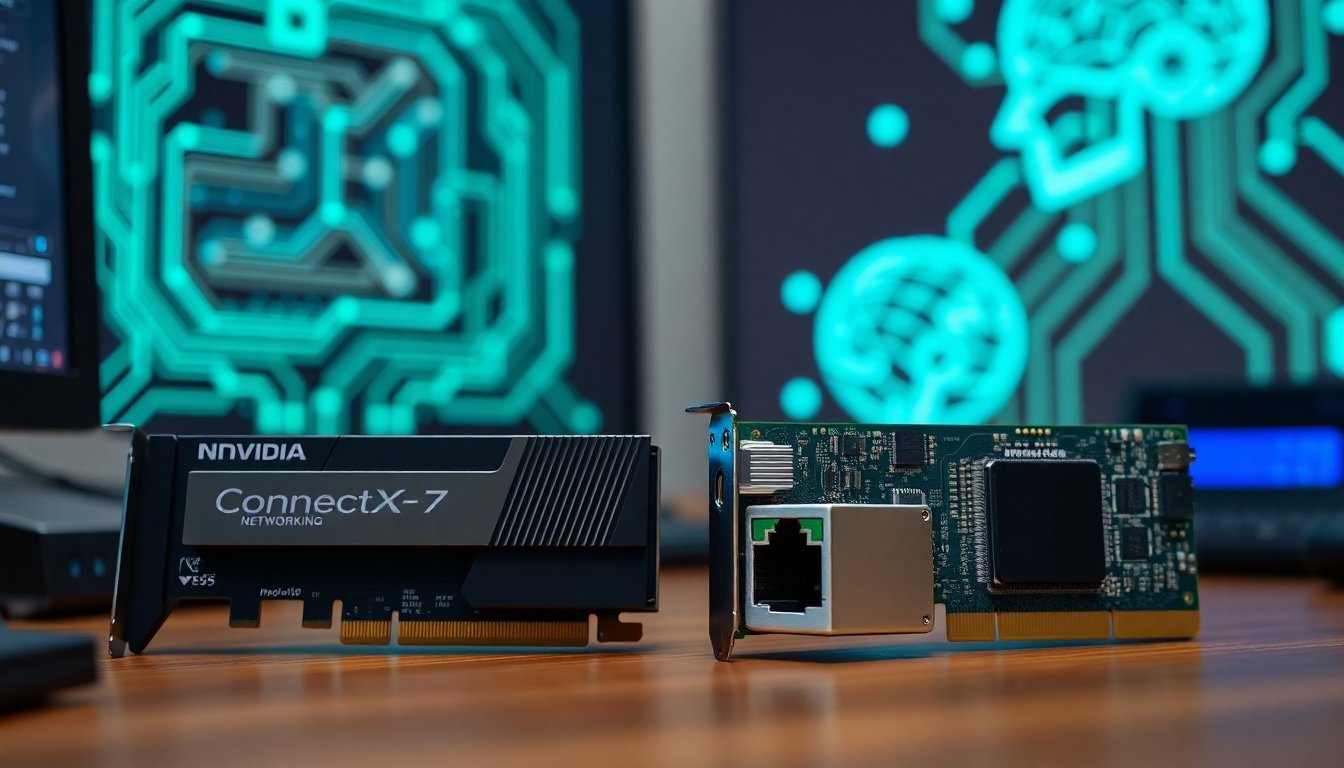
What exactly is this $11 billion business? It is the high-performance networking fabric that turns a warehouse full of GPUs into a single, coherent supercomputer. As AI models grow from billions to trillions of parameters, the bottleneck shifts from raw compute inside a chip to the communication between chips, servers, and data center racks. Nvidia’s networking solutions, particularly its NDR InfiniBand technology, are designed to minimize this latency, creating what the company calls the "AI factory." The revenue surge is a direct proxy for the scale of these factories being built by every major cloud provider and AI lab.
The strategic brilliance lies in bundling. Nvidia doesn't just sell a GPU; it sells a reference architecture—the GPU, the networking cards, the switches, and the software to manage it all. This creates immense lock-in. Adopting Nvidia networking isn't merely an optimization; for many customers building at the frontier, it's a necessity to achieve the promised performance of the Nvidia GPUs they've already purchased. The networking division is the glue that makes the whole system indispensable.
From Chipmaker to Systems Sovereign
This financial milestone matters because it redefines Nvidia’s competitive moat and the structure of the entire AI infrastructure market. For years, the threat to Nvidia was seen as other chip designers—AMD, Intel, or a swarm of startups—catching up on silicon. The $11 billion networking figure reveals that the battlefield has expanded. Nvidia is no longer just a chip company; it is a full-stack systems company. Its real competition is now other system architects, like Cisco or Arista in networking, or the internal engineering teams at hyperscalers trying to build their own optimized fabrics.
The value is shifting from the component to the platform. An AI accelerator is just a very fast calculator if it can't be efficiently linked to thousands of others. By controlling the networking layer, Nvidia ensures its GPUs remain the center of the AI universe. This vertical integration creates a formidable barrier to entry that is about systems engineering and software ecosystems as much as it is about semiconductor physics.
The Mellanox Masterstroke and the Coming Counter-Strategy
To understand this shift, you must look back to the $6.9 billion acquisition of Mellanox in 2019—a move initially viewed as a strategic, if expensive, adjacencies play. Under the leadership of CEO Jensen Huang, it has proven to be one of the most prescient deals in tech history. It gave Nvidia control over the high-performance networking standard that its most demanding customers rely on. The people behind this—the Mellanox engineering teams integrated into Nvidia and the executives who championed the deal—are the quiet architects of this second pillar.
This success will inevitably galvanize competitors. We are already seeing the response. The Ultra Ethernet Consortium, backed by major players including AMD, Intel, Microsoft, and Meta, is a direct attempt to create an open, high-performance Ethernet alternative to Nvidia's InfiniBand stack. Cloud providers like Google and Amazon are aggressively developing their own internal networking silicon and fabrics (like Google's Jupiter, Amazon's Nitro) to reduce dependency. The next phase of competition will be a war of fabrics, not just chips.
What Happens Next: The Platform War Intensifies
Looking forward, the trajectory is clear. Nvidia will continue to deepen the integration between its silicon, networking, and software (CUDA, AI Enterprise) to further elevate its platform value. We should expect future announcements where networking capabilities are not just bundled but are fundamentally co-designed with new GPU architectures, making the system even more inseparable.
For the broader market, the rise of this networking behemoth will force a strategic reckoning. Competitors and customers alike must decide whether to commit to the Nvidia stack, invest billions in competing open ecosystems, or attempt to build their own. For enterprise buyers, it means the cost of entry for state-of-the-art AI infrastructure will be measured in full-system purchases, not just GPU cards. The silent $11 billion quarter is more than a revenue line; it's the sound of the market consolidating around a new king of systems.

Source and attribution
TechCrunch AI
Nvidia is quietly building a multibillion-dollar behemoth to rival its chips business





Discussion
Add a comment