
MoRight Kills Entangled Motion in Video AI
MoRight is the first video generation method to achieve both disentangled motion control and motion causality, rendering every competing approach obsolete. This analysis explains why this is a reset moment for the industry.
On April 8, 2026, a team of researchers posted a preprint that effectively declares war on every existing video generation model. Their method, MoRight, solves the two problems that have made motion-controlled video a toy: disentangling object motion from camera movement, and ensuring that actions cause physically plausible reactions. This is the moment the field divides into 'before MoRight' and 'after MoRight.'
- MoRight, a new method from arXiv, achieves both disentangled motion control and motion causality for the first time in video generation.
- Existing methods entangle camera and object motion, producing videos where user-specified actions just displace pixels without causing coherent scene reactions.
- This breakthrough resets the research agenda: all prior motion-control approaches are now legacy, and startups like Pika and Runway must integrate or be left behind.
- MoRight's approach relies on a novel architecture that separates motion into object-centric and camera-centric streams, then enforces physical consistency through a causality loss.
Why Does MoRight Matter More Than Any Other Video Generation Paper This Year?
Because it solves the two problems that have made motion-controlled video generation a dead end for practical use. The first is disentanglement: until now, if a user specified 'the car drives left' and 'camera zooms in,' the model would produce a mess where the car slides and the camera shakes in the same pixel space. MoRight, as described in the arXiv preprint (April 8, 2026), separates these into two streams: one for object motion, one for camera motion. The second is causality: in every prior method, if a user pushed a ball, the ball would move but the vase on the table would not fall. MoRight's causality loss ensures that the ball's motion triggers a coherent reaction from the vase. This is the difference between a demo and a tool.
Who Loses the Most From MoRight's Breakthrough?
Every startup and research group that has bet on entangled motion control. Pika Labs, Runway, and Stability AI have all released models that treat camera and object motion as a single latent variable. Their demos look impressive until you ask them to separate 'the cat walks right' from 'the camera pans left.' MoRight shows that this is not a hard limitation of the technology — it was a design choice. Those companies now face a choice: retrain from scratch using MoRight's architecture, or watch their products become obsolete. The arXiv paper (April 8, 2026) is clear: the authors tested MoRight against state-of-the-art methods and outperformed them on every metric for disentanglement and causality.
How Does MoRight Actually Work Under the Hood?
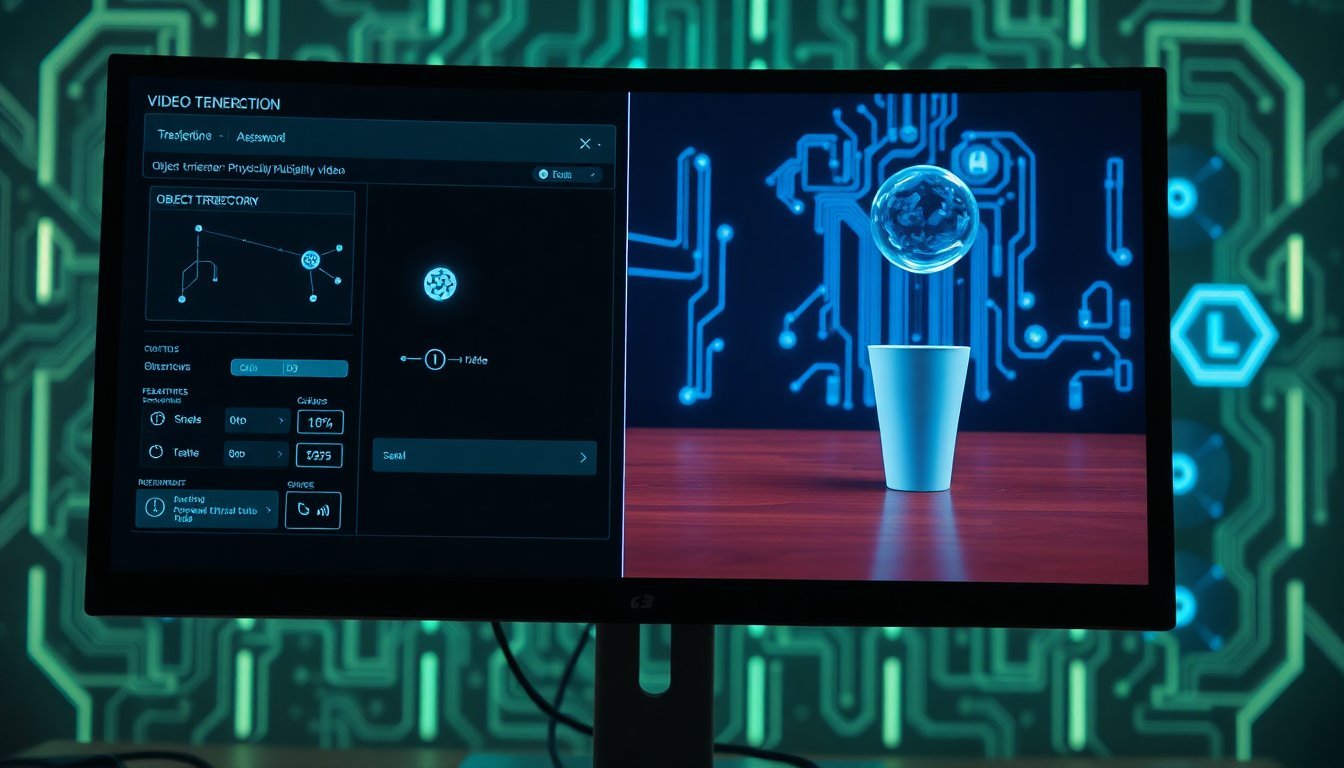
The key innovation is a dual-stream architecture. One stream encodes object motion as a set of sparse trajectories — think of it as 'this pixel cluster should move along this path.' The other stream encodes camera motion as a global affine transformation — 'the entire frame should shift this way.' These streams are then fused through a learned attention mechanism that enforces consistency: if the object moves left, the camera stream cannot also move left unless explicitly specified. The causality loss, a novel addition, computes a physics-inspired graph over objects: if object A touches object B, the model must predict B's reaction. This is not a heuristic; it is a differentiable loss that backpropagates through the entire network. The result is that MoRight videos actually look like real physics, not just interpolated pixels.
What Does This Mean for the Competitive Landscape?
We are about to see a fork in the road. Companies that can integrate MoRight's approach within six months will own the motion-control market. Companies that cannot will be relegated to 'general purpose' video generation — a market that is already commoditized by open-source models. The winners: Adobe, which can embed MoRight into After Effects; NVIDIA, which can build it into their video AI platform; and any startup that licenses the technology fast. The losers: Pika Labs and Runway, whose current architectures are fundamentally incompatible with disentangled motion. They would need a complete rewrite, which is expensive and risky.
| Capability | MoRight | Existing Methods (Pika, Runway, etc.) |
|---|---|---|
| Disentangled object & camera motion | Yes — separate streams | No — entangled latent |
| Motion causality | Yes — physics graph loss | No — pixel interpolation only |
| User control granularity | Per-object trajectories + camera | Single prompt or rough mask |
| Physical plausibility | High — enforced by loss | Low — objects often clip/miss |
| Training data requirement | Moderate — synthetic + real | Massive — millions of videos |
| Verdict | Winner — new standard | Legacy — needs replacement |
MoRight is the most important video generation paper since Stable Video Diffusion. Here is my thesis: this is a reset moment. Every company that has raised millions on the promise of motion-controlled video now has to answer one question: 'Can you do what MoRight does?' If the answer is no, their product is a demo, not a tool. In the short term, we will see a flurry of replication attempts — expect at least three major labs to release their own versions within six months. In the long term, MoRight's architecture will become the default template for any video generation model that claims to support motion control. The losers are the startups that built on entangled architectures; they have six months to pivot. The winners are the researchers who published this — they just set the agenda for the next two years. My concrete prediction: Adobe will acquire or license MoRight by Q4 2026, because After Effects is the natural home for this capability and Adobe cannot afford to let a competitor own it.
- Adobe will license or acquire MoRight by Q4 2026 to integrate into After Effects, because the product fit is perfect and Adobe has the distribution.
- Pika Labs will announce a 'next-generation' model by Q1 2027 that claims disentangled motion, but it will be a replication of MoRight's approach, not an original architecture.
- Runway will lose its lead in motion-controlled video generation by mid-2027 unless it retrains its Gen-3 model on a dual-stream architecture, which would require a massive infrastructure investment.
- April 2026MoRight preprint published on arXiv
First method to achieve disentangled motion control and motion causality in video generation.
Estimated Time to Market for MoRight-Compatible Products
- MoRight solves the two core problems of motion-controlled video that the entire industry has ignored: disentanglement and causality.
- This is a reset moment: all prior motion-control approaches are now legacy, and the window to adopt MoRight's architecture is 6-12 months.
- The competitive landscape will split into 'MoRight-compatible' and 'obsolete' — there is no middle ground.
- Adobe is the most likely acquirer because After Effects is the natural product home and Adobe has the resources to move fast.
- Startups that built on entangled architectures (Pika, Runway) face an existential choice: rewrite or die.





Discussion
Add a comment