
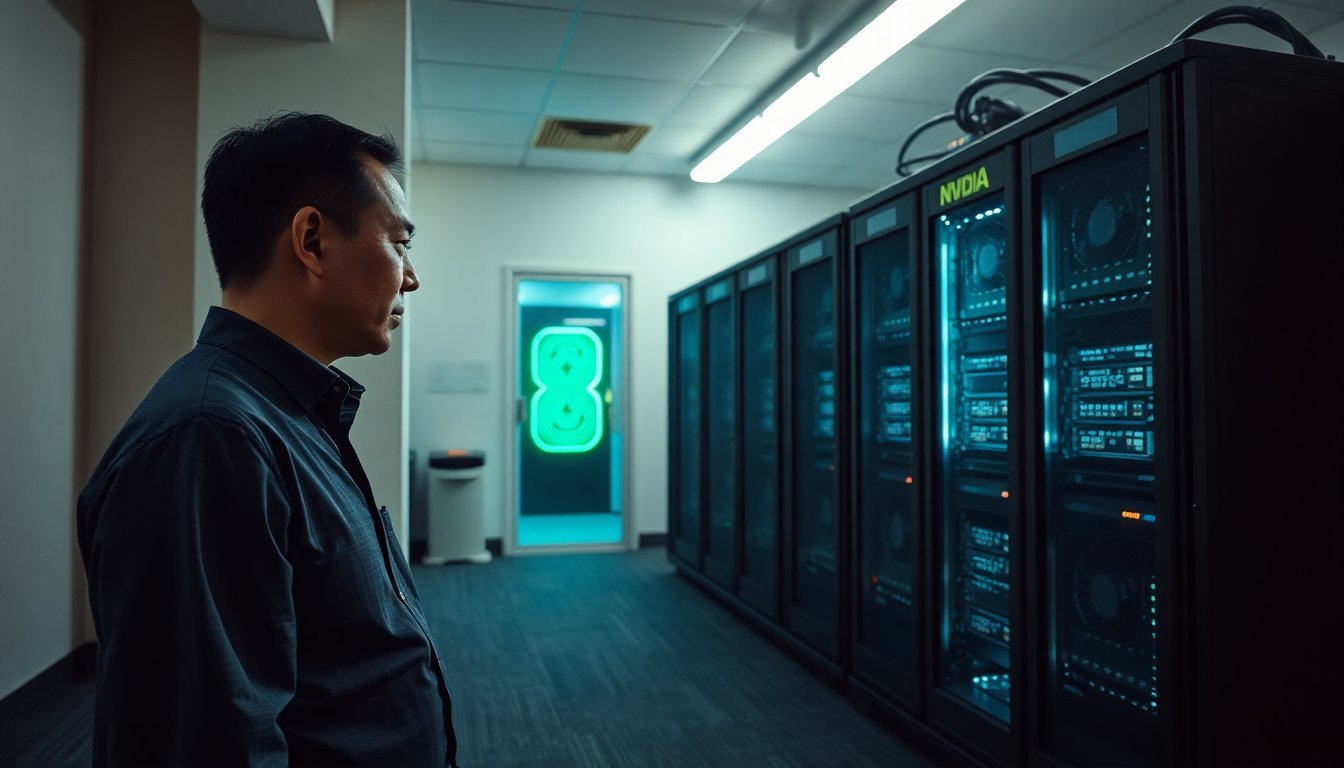
Moonshot's Kimi Runs on Nvidia: China's AI Dependence Exposed
Bloomberg revealed that Moonshot's Kimi models are trained on ~20,000 Nvidia Hopper chips obtained via Alibaba, proving that US export controls are being circumvented and that China's AI infrastructure is still deeply dependent on Nvidia. This analysis breaks down what the arrangement means for Moonshot, Alibaba, and the future of US-China tech competition.
Chinese AI startup Moonshot is training its Kimi models on roughly 20,000 Nvidia Hopper chips, supplied through a computing agreement with Alibaba, according to Bloomberg. The revelation, reported by Bloomberg's Peter Elstrom on July 31, 2026, cuts through the noise of China's 'self-reliance' narrative and shows that US silicon remains the backbone of China's most ambitious AI projects.
- Moonshot AI, the Chinese startup behind the Kimi models, has been using around 20,000 Nvidia Hopper chips to train its frontier models, according to Bloomberg sources.
- The chips were supplied through a computing agreement with Alibaba, making Alibaba a critical intermediary in China's AI compute supply chain.
- This deal reveals that despite US export controls, Nvidia hardware remains the foundation of China's most advanced AI efforts—and that Alibaba is now a power broker in Chinese AI.
How Did Moonshot Get 20,000 Nvidia Hopper Chips?
According to Bloomberg, Moonshot's Kimi models are powered in part by around 20,000 Nvidia Hopper chips supplied through a computing agreement with Alibaba. The deal, reported by Bloomberg's Peter Elstrom on July 31, 2026, gives Moonshot access to the same class of hardware that powers OpenAI and Anthropic in the US. The arrangement is notable because it bypasses the direct-sale restrictions that have limited Nvidia's sales to Chinese companies.
Alibaba, which already operates one of China's largest cloud networks, appears to be leveraging its existing Nvidia inventory—or its access to it—to become a compute broker for AI startups. This is not a violation of US export controls per se; rather, it's a gray-market workaround that exploits the fact that Alibaba's data centers were stocked with Hopper chips before the most stringent restrictions were tightened.
Why Does This Undermine China's 'Self-Reliance' Narrative?
The revelation is a direct blow to the official Chinese narrative that domestic AI innovation is independent of US technology. For years, Chinese state media and companies like Huawei have pushed the line that China can build world-class AI with domestic chips like the Ascend series. But Moonshot's reliance on Nvidia Hopper chips tells a different story: when it comes to training frontier models, Chinese companies still prefer American silicon.
According to Bloomberg's report, the 20,000 Hopper chips are a significant number—comparable to what a US frontier lab might deploy. If Chinese startups could achieve the same results with domestic hardware, they wouldn't need to pay a premium for Nvidia chips through intermediaries. The fact that they do is evidence that the 'self-reliance' narrative is more political than technical.

What Does This Deal Mean for Alibaba's Role in AI?
Alibaba is no longer just a cloud provider; it's becoming the de facto compute broker for China's AI ecosystem. By supplying Moonshot with Nvidia Hopper chips, Alibaba positions itself as the gatekeeper of cutting-edge compute. This is a double-edged sword: it gives Alibaba enormous leverage over startups, but it also makes Alibaba a target for US regulators who may see this as a deliberate evasion of export controls.
Alibaba's own AI models, like Qwen, compete directly with Moonshot's Kimi. Yet Alibaba is still willing to supply its competitor with compute. This suggests that Alibaba values the strategic position of being the compute provider more than it fears Moonshot's competition. It's a classic platform play: control the infrastructure, and you control the ecosystem.
Who Benefits and Who Loses From This Arrangement?
The obvious winner is Moonshot, which gains access to world-class compute without the political risk of buying Nvidia directly. Alibaba also wins by cementing its role as a critical infrastructure provider. But the losers are more interesting: Chinese chipmakers like Huawei and Cambricon, who are trying to sell domestic alternatives, now face an even steeper uphill battle. If the most promising Chinese AI startup is still using Nvidia, why would anyone buy domestic chips?
| Dimension | Moonshot (via Alibaba) | Direct Nvidia Purchase | Domestic Chips (Huawei Ascend) |
|---|---|---|---|
| Access to Hopper-class compute | Yes (via Alibaba) | Restricted by US export controls | No equivalent |
| Political risk | Low (indirect) | High (direct violation) | Low (domestic) |
| Performance for frontier training | High | High | Unproven |
| Cost | Premium (Alibaba markup) | List price | Subsidized |
| Dependency risk | High (Alibaba controls access) | High (Nvidia controls supply) | Low (domestic supply) |
| Verdict | Moonshot's choice is pragmatic but creates a new dependency on Alibaba, which may prove more costly than direct Nvidia access. | ||
What Does This Reveal About US Export Controls?
US export controls have not stopped China from accessing Nvidia's best chips; they have only made access more expensive and more convoluted. According to Bloomberg's reporting, the Moonshot-Alibaba deal is a clear example of how Chinese companies are finding workarounds. The US government can block direct sales, but it cannot easily police every intermediary or every cloud provider that has pre-existing Nvidia inventory.
This is a critical lesson for US policymakers: export controls are a speed bump, not a wall. They slow China down and raise costs, but they don't prevent the diffusion of critical technology. The real question is whether the US will tighten the screws on intermediaries like Alibaba, or whether it will accept that some leakage is inevitable.
My thesis: Moonshot's Nvidia-backed training is the clearest evidence yet that China's AI ambitions are still built on American silicon, and that 'self-reliance' is a myth.
In the short term, this deal gives Moonshot a competitive edge over Chinese rivals who lack access to Hopper-class compute. But in the long term, it makes Moonshot vulnerable to Alibaba's whims and to any future US action against Alibaba's data centers. The bigger story is that Alibaba is emerging as China's AI compute kingmaker—a role that could make it more powerful than any single AI model developer.
Who gains? Moonshot and Alibaba. Who loses? Domestic Chinese chipmakers, who now look like second-class citizens in their own market. And the US loses too, because its export controls are being circumvented with impunity.
My concrete prediction: By June 2027, the US Commerce Department will add Alibaba's cloud division to the Entity List for facilitating Nvidia chip transfers to Moonshot, triggering a diplomatic crisis and a scramble among Chinese AI startups to secure alternative compute.
Predictions
- The US Commerce Department will add Alibaba's cloud division to the Entity List by June 2027, citing the Moonshot chip deal as evidence of export control evasion.
- Moonshot will announce a strategic partnership with Huawei to develop domestic compute alternatives within 18 months, as a hedge against Alibaba's leverage and US action.
- Chinese AI startups will increasingly consolidate around a handful of compute brokers like Alibaba, making it harder for new entrants to compete without ties to a cloud giant.
Timeline
Chart
Estimated Nvidia Hopper chips in China by source (2026):
- Direct Nvidia sales: 0 (blocked)
- Via intermediaries (Alibaba, others): 50,000 (estimated)
- Gray market: 20,000 (estimated)
Article Summary
- Moonshot's reliance on Nvidia chips proves that Chinese AI labs still prefer US hardware for frontier training, despite export controls.
- Alibaba is now a critical compute broker, giving it outsized influence over China's AI startup ecosystem.
- US export controls are leaking, and the next logical step is action against intermediaries like Alibaba.
- Domestic Chinese chipmakers are losing the battle for mindshare, even if they win some government contracts.
- This deal is a reminder that in AI, compute is the ultimate currency—and Nvidia still prints it.
Source and attribution
Bloomberg Technology
Moonshot's Kimi Built With Nvidia Compute


Discussion
Add a comment