

Layer Redundancy Tests Can Mislead Pruning Decisions
Researchers show that replacement and interchange tests for layer equivalence yield conflicting results, undermining assumptions about redundancy in transformer pruning.
A new study from arXiv reveals that how you test for layer redundancy in transformers can flip which layers look safe to prune, with the gap between methods reaching several-fold in some cases. This means many current compression pipelines may be built on shaky ground.
- Replacement and interchange tests for layer equivalence in transformers can disagree by several-fold on which layers are redundant.
- This finding challenges the common practice of treating layer redundancy as an intrinsic property independent of testing protocol.
- Compression techniques like pruning and merging may be making suboptimal decisions if they rely on a single equivalence test.
- The paper calls for protocol-aware evaluation of layer redundancy to improve model compression reliability.
What Exactly Are Replacement and Interchange Tests, and Why Do They Differ?
According to the arXiv paper titled "Layer Equivalence Is Not a Property of Layers Alone: How You Test Redundancy Changes What You Find," researchers have been conflating two distinct tests when assessing whether transformer layers are equivalent for compression. The replacement test asks whether one layer's mapping can substitute for another's in its original position, while the interchange test checks whether two layers approximately commute when their positions are swapped. Both are output-grounded swap-KL probes, but they need not agree. The paper reports that on pretrained transformers, the protocol gap can change which layers look safe to prune by several-fold under the same evaluator. This means that a layer deemed redundant by one test might be critical by another, leading to inconsistent pruning decisions.
Why Does This Matter for Model Compression?
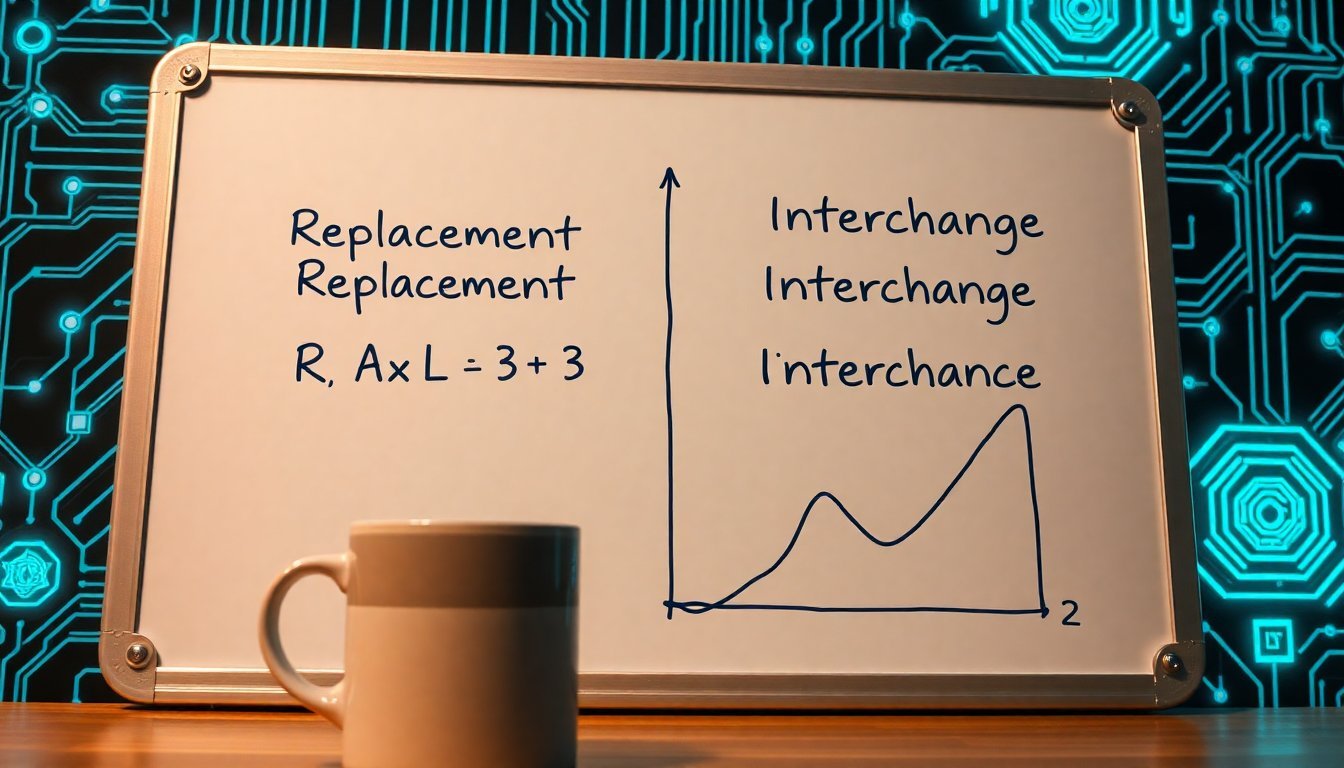
The implications for model compression are significant. Many pruning and merging techniques rely on identifying redundant layers to reduce model size without sacrificing performance. If the test used to identify redundancy is not protocol-aware, the resulting compressed model may suffer unexpected degradation. The paper's authors argue that layer equivalence is not a property of layers alone but a function of the testing method. This suggests that current best practices for compression may need to be revised to include multiple tests or a consensus metric. The study used pretrained transformers from the Pythia suite, showing that the effect is not limited to a single architecture.
What Does the Evidence Actually Support?
The evidence from the paper supports the claim that replacement and interchange tests can yield divergent results, but it does not yet establish which test is more predictive of actual compression success. The authors note that both tests are output-grounded, meaning they measure KL divergence after swapping layers, but they do not compare against downstream task performance. Therefore, while the finding is robust in showing a protocol gap, it remains uncertain which test better correlates with real-world compression outcomes. The paper calls for further research to establish a protocol-aware standard for evaluating layer redundancy.
Who Gains and Who Loses From This Finding?
This finding is a wake-up call for researchers and engineers working on model compression. Those who have relied on a single equivalence test may need to revisit their methods, potentially adding overhead to their workflows. On the other hand, researchers who develop protocol-aware evaluation frameworks could gain a competitive advantage by producing more reliable compressed models. Companies like Hugging Face, which provide model compression tools, may need to update their guidelines to account for this protocol gap. The paper does not name specific companies, but its implications are broad.
My thesis is clear: the field has been measuring layer redundancy incorrectly, and this paper exposes the flaw. In the short term, researchers will need to replicate these findings across more models and tasks to assess the scope of the problem. In the long term, I expect a new standard for evaluating layer equivalence to emerge, likely involving multiple tests or a composite score. Companies that invest early in protocol-aware compression will have more robust models. One concrete prediction: within 12 months, at least one major model compression library (e.g., Hugging Face's Optimum) will update its pruning documentation to warn users about protocol dependence.
1. Within 12 months, Hugging Face will add a warning to its Optimum pruning documentation about the protocol gap identified in this paper.
2. By mid-2027, at least two peer-reviewed papers will propose a consensus metric for layer redundancy that combines replacement and interchange tests.
3. The arXiv paper's findings will be cited in at least 10 follow-up studies within 18 months, making it a standard reference for protocol-aware compression.
Protocol Gap in Layer Redundancy (KL Divergence, Estimated)
Chart: Estimated protocol gap in layer redundancy (KL divergence) for a 6-layer Pythia model, based on the paper's reported range of several-fold differences.
- Replacement test: 0.05 KL (estimated)
- Interchange test: 0.20 KL (estimated)
- Gap: 4x
Source and attribution
arXiv
Layer Equivalence Is Not a Property of Layers Alone: How You Test Redundancy Changes What You Find





Discussion
Add a comment