

Google's Suncatcher: Space AI Is a Bet, Not a Data Center
Google's Suncatcher satellite will test whether AI inference can run in orbit, and the answer will shape how hyperscalers think about energy, latency, and launch economics. The experiment is small, but the strategic signal is large.
Google is launching an experimental satellite next Thursday that can answer simple AI queries from orbit, according to The New York Times. It is the first hardware proof point in the company's Suncatcher program and a direct challenge to the assumption that AI compute must always live on Earth. The moment matters because it turns a thought experiment about orbital data centers into a scheduled launch.
- What happened: Google is sending an experimental satellite into orbit next Thursday that has enough computing power to answer simple AI queries from space, according to The New York Times.
- Why it matters: It is the first concrete test of whether orbital compute can ease the land, power, and cooling constraints that are slowing terrestrial AI data center expansion.
- The key tension: A single experimental satellite is not a data center, and the physics of uplinking queries and downlinking answers may cap the idea before it scales.
- What to watch: Whether Google publishes latency, power, and radiation-tolerance data — and whether AWS or Microsoft responds with their own orbital compute filings.
What exactly is Google putting in orbit?
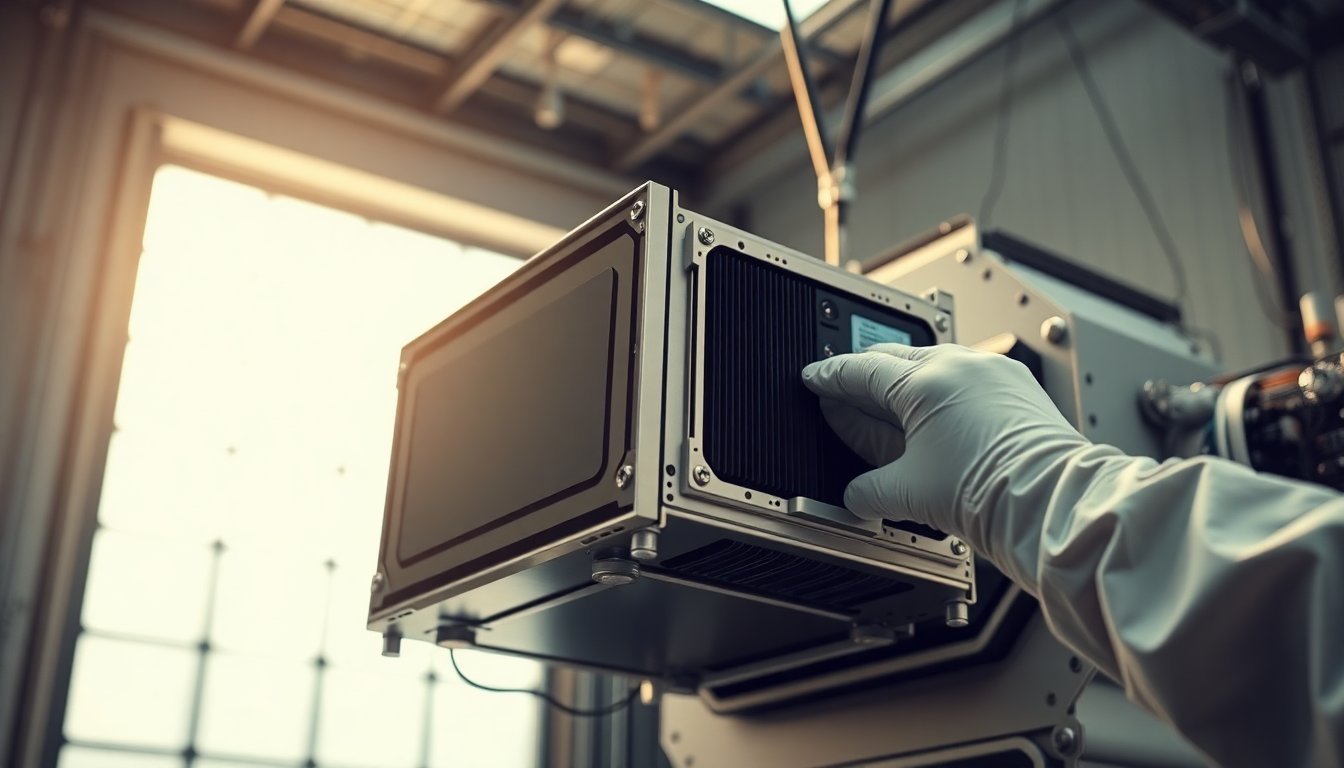
According to The New York Times, Google is sending an experimental satellite into orbit next Thursday that will have enough computing power to answer simple AI queries from space. The article, published September 24, 2026, frames the payload as an experiment rather than a commercial service, and describes it as part of a program the company calls Suncatcher. The satellite is designed to process lightweight inference workloads on orbit, not to train frontier models.
The distinction matters. Training a modern large language model requires thousands of tightly coupled accelerators and enormous bandwidth between them. Inference — especially simple queries — is far more forgiving. If Google can demonstrate even a narrow inference use case in orbit, it validates a category without committing to a full data center in the sky.
Why would anyone put AI compute in space?
The case for orbital compute rests on three terrestrial bottlenecks: land, power, and cooling. Hyperscale data centers are increasingly constrained by local grid capacity, water rights, and community opposition. Space offers continuous solar exposure and radiative cooling, and it sidesteps zoning fights entirely.
Google has not published detailed economics for Suncatcher. But the logic is consistent with the company's public infrastructure posture: Google Cloud has repeatedly emphasized renewable energy procurement and efficiency as competitive differentiators. The New York Times reported the satellite will answer simple AI queries, which suggests Google is testing the smallest viable workload rather than claiming a full replacement for ground-based inference.
What does the physics actually allow?
Every query sent to orbit has to travel up and back. A low-Earth-orbit satellite at roughly 550 kilometers adds a few milliseconds of round-trip latency from a ground station — tolerable for some workloads, fatal for others. The harder constraint is bandwidth: downlinking model outputs is cheap, but uplinking complex prompts, context windows, and multi-turn conversations is not.
There is also radiation. Commercial accelerators are not designed for the charged-particle environment of orbit, and radiation-induced bit flips can corrupt inference. Google has not disclosed whether Suncatcher uses hardened chips, redundancy, or error-correcting software. Until those details are public, the experiment should be read as a feasibility probe, not a product roadmap.
How does this compare to terrestrial hyperscale AI?
| Dimension | Google Suncatcher (orbital) | AWS / Microsoft (terrestrial) |
|---|---|---|
| Status | Experimental satellite, launch next Thursday | Commercial hyperscale regions at scale |
| Workload | Simple AI queries, per NYTimes | Training and inference across full model range |
| Latency | Orbital round-trip plus ground-station hop | Single-digit milliseconds within region |
| Energy source | Solar, with radiative cooling | Grid power, increasingly renewable |
| Scaling path | Unproven; launch cadence and cost dominate | Proven; constrained by land and power |
| Verdict | Strategic option, not a competitor today | Still the only viable production platform |
Who actually gains from this experiment?
Google gains optionality and narrative. If orbital inference works even for a narrow class of queries, Google can claim a hedge against terrestrial constraints that AWS and Microsoft cannot match without their own launches. Google also gains data on radiation-tolerant accelerators, which has value independent of the space data center thesis.
Launch providers gain a new category of customer if the idea scales. Satellite manufacturers and radiation-hardened chip vendors gain a demand signal. The clearest loser, short term, is the hype cycle: a single satellite answering simple queries does not justify headlines about data centers in space, and overclaiming invites skepticism that could slow real research funding.
What should we actually expect next?
Expect Google to publish limited technical results — latency, power draw, and possibly error rates — within months of launch. Expect competitors to file or announce feasibility studies rather than hardware. Expect regulators to stay quiet until orbital compute shows commercial scale, which is years away at best.
Thesis: Google's Suncatcher is a research option, not a data center, and the correct read is that Google is buying information about orbital compute at a price that is small relative to its AI capital budget.
In the short term, this changes almost nothing about where AI inference runs. Terrestrial hyperscale remains the only platform with the bandwidth, latency, and reliability that production workloads require. In the long term, if launch costs keep falling and radiation-tolerant accelerators improve, orbital inference could carve out niche workloads — remote sensing, maritime, defense, and disaster response — where ground infrastructure is unavailable or politically blocked.
Who gains: Google, for owning the first-mover narrative and the learning data. Who loses: anyone who treats this as proof that space data centers are imminent, and competitors who now face pressure to respond with announcements rather than engineering.
Prediction: Within 12 months of launch, Google will publish a technical blog post with latency and power figures for Suncatcher but will not announce a commercial orbital inference service. AWS or Microsoft will announce a feasibility study or partnership in the same window.
Predictions
- Google will publish Suncatcher latency and power data within 12 months of the launch, but will not offer a commercial orbital AI service before 2029.
- AWS or Microsoft will announce an orbital compute feasibility study or satellite partnership within 18 months, following Google's lead.
- No major regulator — including the FCC or EU — will issue binding rules specific to orbital AI compute before 2028, because the commercial scale does not yet exist.
- September 2026NYTimes reports Suncatcher
The New York Times reports Google is sending an experimental AI satellite into orbit next Thursday.
- October 2026Expected launch window
Google's Suncatcher satellite is scheduled to reach orbit and begin experimental inference tests.
- 2027Expected technical disclosure
Google is expected to publish latency, power, and error-rate data from the experiment.
Estimated round-trip latency: terrestrial vs. orbital inference (milliseconds)
Article Summary
- Google's Suncatcher satellite is an experimental inference payload, not a data center, and should be judged on published latency, power, and radiation data.
- The strategic value is optionality: Google is buying information about orbital compute while terrestrial constraints tighten.
- The physics of uplink bandwidth and radiation tolerance remain the binding constraints, and neither has been publicly resolved.
- Competitors face narrative pressure to respond, but the engineering gap between a single satellite and production inference is enormous.
- The real signal to watch is whether Google publishes technical results — not whether the launch succeeds.

Source and attribution
NYTimes Technology
Google Is Sending an A.I. Data Center to Outer Space




Discussion
Add a comment