
Google's ARD Spec: Agent Lock-In or Discovery Standard?
Google's ARD aims to standardize how AI agents discover resources, but developers must weigh the benefits of a unified protocol against the risks of deepening dependency on Google's infrastructure.
On June 17, 2026, Google proposed the Agentic Resource Discovery (ARD) specification, a protocol for AI agents to dynamically discover and interact with web-hosted resources. This is not just another API spec — it's Google's bid to define how autonomous agents find and call services, a move that could reshape the agent ecosystem's plumbing.
- Google introduced the Agentic Resource Discovery (ARD) specification on June 17, 2026, to let AI agents dynamically discover and interact with resources via a standard protocol.
- ARD is built on HTTP and JSON, aiming to replace ad-hoc agent-to-API integrations with a uniform discovery layer.
- The spec is currently a proposal — not an adopted standard — and faces competition from open-source alternatives like Agent Communication Protocol (ACP).
What Exactly Is the ARD Specification and How Does It Change Agent Workflows?
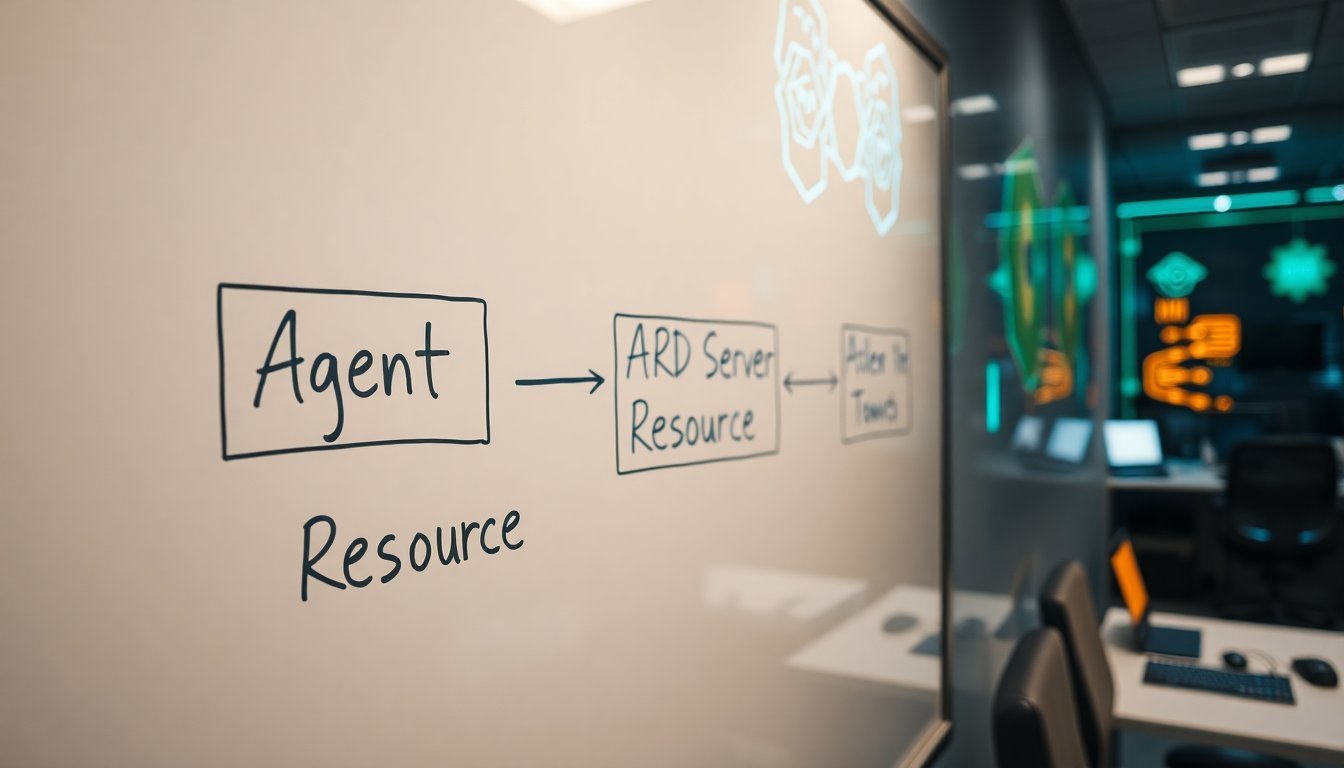
According to Google's official blog post, the ARD specification defines a standard way for an AI agent to ask, "What resources are available here?" and receive a structured list of endpoints, capabilities, and authentication requirements. The key change is that agents no longer need hard-coded API endpoints or pre-configured service lists. Instead, they can query a resource server at runtime, discover available actions, and adapt their behavior accordingly. For example, a travel-booking agent could discover hotels, flights, and car rental services by querying a single ARD endpoint, rather than integrating with each provider separately.
The specification is built on familiar web standards: HTTP, JSON, and standard authentication flows (OAuth 2.0). This means existing web services can adopt ARD with minimal changes — a point Google emphasizes in its documentation. However, the spec is currently a proposal, not a ratified standard. Google has published it on a dedicated site (agenticresourcediscovery.org) and is soliciting feedback from the community.
Who Benefits Most from ARD — and Who Loses?
ARD is a clear win for Google Cloud and its ecosystem of API providers. By offering a standard discovery protocol, Google reduces the friction for agents to use Google-hosted services (e.g., Google Maps, Calendar, or Vertex AI). This strengthens Google's position as the default agent platform, especially for enterprise customers who already use GCP. According to the ARD specification site, the protocol is designed to be cloud-agnostic, but the initial implementation and documentation are heavily tied to Google's infrastructure.
The losers are smaller API providers and open-source agent frameworks that have invested in custom integration patterns. If ARD becomes the de facto standard, these players will either need to adopt it (and cede control to Google) or risk being invisible to agents. Open-source alternatives like the Agent Communication Protocol (ACP) from the AI Agent Protocol community offer a more decentralized approach, but they lack Google's marketing muscle and existing ecosystem.
What Are the Operational Tradeoffs for Developers Adopting ARD?
Developers face a classic platform risk vs. convenience tradeoff. On the plus side, ARD dramatically simplifies agent development. Instead of writing custom code for each service, an agent can use a generic ARD client to discover and call any ARD-compliant resource. This reduces development time and maintenance overhead. Google's documentation claims that "a single ARD client can interact with any ARD-compliant resource," which is a powerful promise.
On the downside, adopting ARD ties an agent's resource discovery to a Google-defined protocol. If Google changes the spec, adds fees, or prioritizes its own services in discovery results, developers have limited recourse. The spec is open-source, but governance is currently controlled by Google. Developers must also consider that ARD is not yet an industry standard — it competes with other proposals like the W3C Web of Things (WoT) Thing Description and OpenAPI-based discovery. The table below compares ARD with its main alternatives.
How Does ARD Compare to Existing Discovery Protocols?
| Feature | ARD (Google) | OpenAPI + Service Discovery | W3C Web of Things (WoT) |
|---|---|---|---|
| Primary Use Case | Agent-to-resource discovery | REST API documentation | IoT device discovery |
| Discovery Mechanism | Dynamic query to resource server | Static spec files via registry | Thing Description via HTTP/CoAP |
| Authentication | OAuth 2.0 built-in | External (per API) | External (per Thing) |
| Agent Adaptation | Designed for autonomous agents | Manual integration | Limited to device control |
| Governance | Google-controlled (currently) | OpenAPI Initiative (Linux Foundation) | W3C |
| Maturity | Proposal (June 2026) | Widely adopted | Standard, niche adoption |
| Verdict | Best for agent-native workflows, but risky due to single-vendor governance | Safer for existing APIs, but not agent-optimized | Best for IoT, not general agent use |
What Should Developers Do About ARD Right Now?
My advice: experiment, but don't bet the farm. ARD is promising for greenfield agent projects, especially those already on Google Cloud. Build a small proof-of-concept that uses ARD to discover and call a few services. Measure the integration time vs. manual API wiring. But for production systems that need to work across multiple cloud providers or with legacy APIs, stick with OpenAPI-based discovery for now — it's more mature and vendor-neutral.
Also, monitor the governance discussion. If Google transfers ARD to a neutral foundation (e.g., Linux Foundation or W3C), the risk of lock-in drops significantly. If Google retains control, treat ARD as a Google Cloud feature, not an industry standard.
My Analysis: ARD is a smart strategic move by Google to extend its influence into the agent runtime layer. The spec is technically sound — it solves a real problem — but the governance model is the elephant in the room.
Short-term, ARD will accelerate agent development on Google Cloud, giving GCP a competitive edge over AWS and Azure in the agent platform race. Long-term, if ARD becomes a de facto standard, Google gains a privileged position in the agent-to-service economy, potentially extracting rent or steering traffic to its own services. The open-source community will likely counter with a more decentralized alternative, but fragmentation could slow adoption.
The biggest winner is Google Cloud. The biggest losers are smaller API providers who will face pressure to adopt ARD or risk being invisible to agents. Developers gain convenience but lose optionality. My prediction: within 18 months, Google will announce that ARD is being contributed to a neutral foundation, but the core implementation will remain tied to Google's cloud services.
- By December 2027, Google will transfer ARD governance to the Linux Foundation or similar body, but the reference implementation will remain optimized for Google Cloud.
- By June 2028, at least 30% of new agent frameworks will support ARD natively, but adoption among enterprise API providers will lag below 10% due to lock-in concerns.
- The EU will launch a preliminary investigation into ARD's impact on agent market competition by Q1 2028.
- ARD is a convenience play, not a technical revolution. The protocol is simple HTTP/JSON — the innovation is in the standardization of agent-to-resource discovery.
- Governance is the critical factor. Until ARD is under neutral control, treat it as a Google Cloud feature, not an industry standard.
- OpenAPI remains the safer bet for multi-cloud agent systems. ARD's agent-native design is compelling, but vendor lock-in risk outweighs convenience for production deployments.
- Google is playing the long game. ARD positions Google as the default agent platform, similar to how Android became the default mobile platform.
- Watch for a competitive response from AWS and Microsoft. Both will likely propose their own agent discovery protocols, leading to a standards war that could confuse developers.
Source and attribution
Hacker News
Agentic Resource Discovery Specification





Discussion
Add a comment