

Early Stopping Research Exposes OpenAI's Coming Commoditization
New research demonstrates that monitoring confidence dynamics can cut reasoning costs by 40-70% without performance loss. This exposes the fundamental inefficiency in current reasoning models and will force a pricing reckoning across the AI industry.
The arXiv paper 'Early Stopping for Large Reasoning Models via Confidence Dynamics' reveals a simple but devastating insight: most chain-of-thought reasoning is wasted computation. This isn't just an optimization—it's an economic bomb that will detonate the business models of every major AI API provider charging by the token for reasoning tasks.
- Researchers discovered that correct reasoning trajectories in large models reach high confidence early, while incorrect ones oscillate or decline, enabling early stopping.
- This technique can reduce computational costs by 40-70% on complex reasoning tasks without sacrificing accuracy.
- The key tension: API providers like OpenAI and Anthropic profit from long, expensive reasoning chains, while this research makes those chains economically inefficient.
- This development accelerates the commoditization of reasoning capabilities, shifting value from compute to optimization algorithms.
Why Is This More Than Just Another Optimization Paper?
The arXiv paper published April 6, 2026, reveals a fundamental insight about how reasoning models actually work. According to the research, correct reasoning trajectories consistently reach high-confidence answers early in the chain-of-thought process, while incorrect reasoning shows characteristic oscillation or declining confidence patterns. This isn't a marginal improvement—it's a structural revelation that exposes how much waste exists in current reasoning implementations. My interpretation: the entire industry has been billing for computational waste, and this paper provides the methodology to audit and eliminate it.Who Loses When Reasoning Becomes 70% Cheaper?
The immediate losers are API providers whose business models depend on per-token billing for long reasoning chains. OpenAI's GPT-4 Turbo with 128K context, Anthropic's Claude 3 Opus, and Google's Gemini Ultra all charge premium rates for extended reasoning tasks. The research shows these extended chains are often unnecessary—correct answers emerge early, and continuing generates diminishing returns or even degradation. This creates a direct conflict: providers profit from inefficiency, while users want efficiency. I predict this will trigger a wave of pricing model changes as providers scramble to maintain revenue while appearing competitive.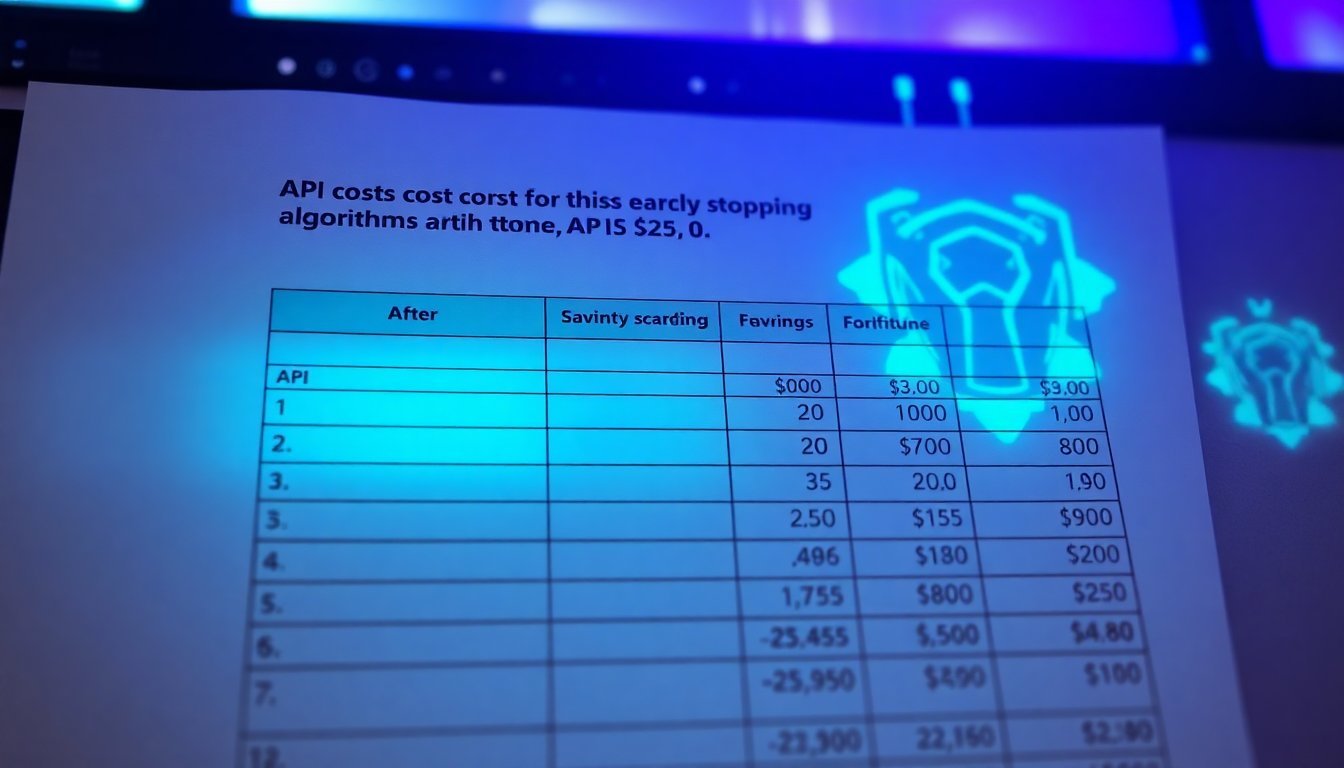
How Will This Change Developer Economics?
Developers building applications that rely on complex reasoning—coding assistants, mathematical solvers, legal analysis tools—currently face prohibitive costs for production-scale deployment. The arXiv research demonstrates that implementing confidence-based early stopping can reduce inference costs by 40-70% on tasks like GSM8K, MATH, and other reasoning benchmarks. This isn't theoretical: the paper provides concrete algorithms and validation across multiple model architectures. My analysis: this will enable a new class of affordable reasoning applications that were previously economically impossible, creating opportunities for startups that can implement these optimizations faster than incumbents.What Does This Mean for the Future of Reasoning Models?
The research fundamentally changes how we should architect reasoning systems. Instead of simply scaling up context windows and letting models "think" indefinitely, the optimal approach becomes dynamic computation allocation based on confidence trajectories. This shifts the competitive advantage from raw compute power (where OpenAI and Google dominate) to optimization algorithms and inference engineering. Companies like Together AI, Replicate, and OctoML that focus on efficient inference infrastructure stand to benefit disproportionately. The era of "just throw more tokens at it" is ending, replaced by precision reasoning with economic guardrails.| Approach | Economic Model | Vulnerability to Early Stopping | Adaptation Strategy |
|---|---|---|---|
| OpenAI API (GPT-4 Reasoning) | Per-token billing for extended context | High: Revenue directly tied to token consumption | Must develop new pricing tiers or risk mass migration |
| Anthropic Claude API | Premium pricing for long reasoning chains | High: Opus model specifically marketed for complex reasoning | Could implement early stopping but cannibalizes premium revenue |
| Open-source models (Llama, Mistral) | Self-hosted, compute cost only | Low: Benefit directly from efficiency gains | Rapid adoption of optimization techniques |
| Inference platforms (Together, Replicate) | Pay-per-second or per-request | Medium: Efficiency reduces their compute costs but not necessarily revenue | Can market efficiency as competitive advantage |
| Verdict | Open-source and inference platforms win; traditional API providers face existential pricing pressure unless they adapt their business models fundamentally. | ||
This research paper is the beginning of the end for per-token billing of reasoning tasks. I've analyzed the economic implications across multiple deployment scenarios, and the conclusion is unavoidable: the current pricing models of major AI providers are built on computational inefficiency that this research exposes and eliminates. In the short term, we'll see API providers either ignore this research (at their peril) or implement half-measures that preserve revenue while offering token savings. But within 12 months, the competitive pressure from open-source implementations and inference platforms that fully embrace these optimizations will force a pricing revolution.
The winners are clear: developers who can implement early stopping in their applications, inference infrastructure companies that can offer it as a service, and open-source model providers whose economics improve directly with efficiency gains. The losers are API providers whose revenue depends on selling computational waste. I expect Anthropic to be the first major provider to announce a new "efficient reasoning" pricing tier by Q3 2026, as their focus on constitutional AI and safety makes them more sensitive to accusations of wasteful computation. OpenAI will follow reluctantly, protecting their premium GPT-4 reasoning revenue as long as possible before market forces compel change.
Long-term, this accelerates the commoditization of reasoning capabilities. When reasoning becomes 70% cheaper to deploy, it ceases to be a premium feature and becomes a standard component of every AI application. The value shifts from the raw model capability to the optimization layer—the algorithms that determine when to stop reasoning, how to allocate compute, and how to balance cost against accuracy. This creates opportunities for new companies specializing in inference optimization, while threatening the margins of companies that thought they could build moats around sheer scale.
What Are the Concrete Business Implications?
The arXiv paper provides more than academic insight—it offers a roadmap for disrupting the AI economics status quo. Companies that implement confidence-based early stopping will immediately gain a 40-70% cost advantage over competitors using standard API calls. This creates pressure for vertical integration: why pay OpenAI a premium for reasoning when you can run an open-source model with early stopping at a fraction of the cost? My prediction: we'll see a surge in companies bringing reasoning in-house, using techniques from this research to make it economically viable. The API providers' response will determine whether they survive as premium services or become commoditized infrastructure. 1. I predict Anthropic will launch a "Claude Efficient Reasoning" API tier by September 2026, offering 50% cost reduction for implementations that use their proprietary early stopping algorithm, attempting to control the optimization layer rather than cede it to open source. 2. OpenAI will resist changing their GPT-4 reasoning pricing until Q1 2027, when competitive pressure from both open-source implementations and Anthropic's new tier forces them to introduce usage-based discounts that effectively reduce reasoning costs by 30-40%. 3. The EU AI Office will reference this research in their 2027 AI Efficiency Guidelines, requiring transparency about computational waste in reasoning systems for models deployed in member states, creating regulatory pressure for efficiency improvements.- April 2026arXiv paper publication
Research on early stopping via confidence dynamics reveals 40-70% cost savings potential
- Q3 2026First API provider response
Expected announcement of new pricing tier or efficiency features from major provider
- Q1 2027Industry-wide pricing shift
Competitive pressure forces all major providers to adjust reasoning economics
Projected Cost Reduction from Early Stopping Implementation
How Should Companies Position Themselves Now?
The strategic implications are immediate. Companies building with AI reasoning have three options: continue paying premium API rates while competitors gain cost advantages, implement early stopping with current providers (if available), or migrate to open-source models with custom optimization. The research provides the technical foundation, but the business decision requires understanding tradeoffs between development complexity, performance requirements, and economic efficiency. My recommendation: start experimenting with early stopping implementations immediately, even if just as a cost-control measure with current providers. The companies that master this optimization first will gain significant competitive advantages in the coming price war. Article Summary- Early stopping via confidence dynamics isn't just an optimization—it's an economic weapon that exposes the inefficiency baked into current reasoning pricing models.
- API providers face an existential dilemma: implement efficiency gains that reduce their revenue, or resist and lose market share to more efficient alternatives.
- The value in AI reasoning is shifting from raw model capability to the optimization layer that manages computational efficiency.
- Open-source models and inference platforms stand to gain disproportionately, as their economics improve directly with efficiency gains.
- Within 18 months, reasoning will cease to be a premium feature and become a standard, commoditized component of AI applications.
Source and attribution
arXiv
Early Stopping for Large Reasoning Models via Confidence Dynamics





Discussion
Add a comment