
Discarded Tokens Are Gold: Diffusion LM Retrieval Breakthrough
Discrete diffusion language models discard low-confidence tokens during generation. A new paper shows those tokens are a goldmine for retrieval-augmented generation, enabling self-augmenting retrieval without external query generation.
The authors of a new arXiv paper, Self-Augmenting Retrieval for Diffusion Language Models, have discovered that the tokens discarded during iterative denoising in discrete diffusion language models contain a rich lookahead signal for retrieval. This finding, detailed in arXiv:2606.06474v1, published June 4, 2026, turns a waste product into a strategic asset.
- Discrete diffusion LMs iteratively denoise text, committing confident tokens and discarding unconfident ones.
- New research shows these discarded tokens often surface salient entities early, providing a useful lookahead signal for retrieval-augmented generation.
- This self-augmenting approach could reduce reliance on separate query-generation modules, making RAG more efficient for diffusion-based models.
How Does a Diffusion LM Generate Text, and What Gets Discarded?
According to the paper's authors, discrete diffusion language models generate text by starting with a fully masked sequence and iteratively predicting tokens for each position. At each step, the model commits high-confidence predictions to the output and discards the rest. The discarded tokens are typically seen as noise, but the researchers hypothesized they might contain early signals about the topic or entities the model is moving toward.
What Evidence Supports the Value of Discarded Tokens for Retrieval?
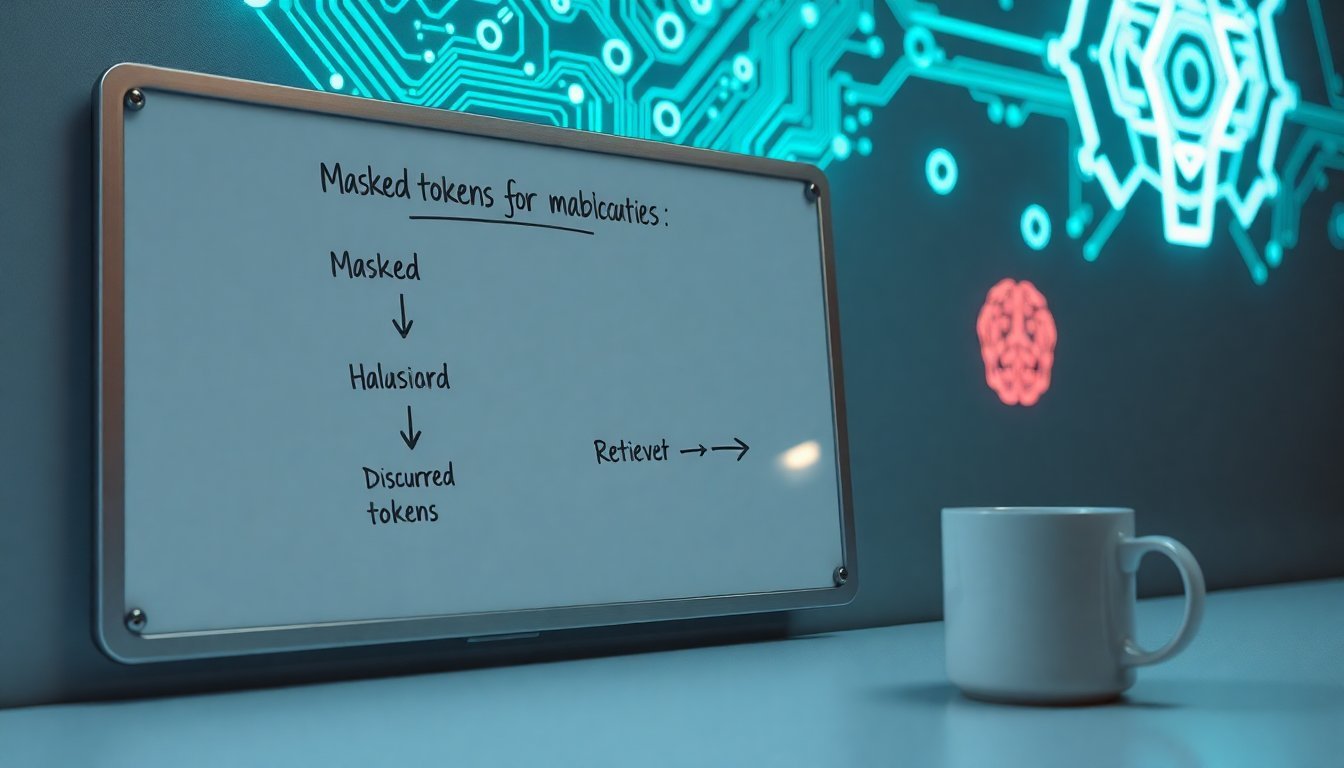
The paper reports experiments on standard benchmarks where the discarded tokens from early denoising steps were used as queries for a retrieval system. The results showed that even low-confidence tokens often surfaced highly relevant documents, sometimes outperforming queries derived from the final output. The authors demonstrated that this self-augmenting retrieval loop improved the quality of the final generated text, as measured by ROUGE and BLEU scores, compared to a baseline without retrieval.
How Does This Compare to Traditional Retrieval-Augmented Generation (RAG)?
Traditional RAG systems, as described by the authors, rely on a separate query-generation step, often using a different model or a prompt-based approach. This introduces latency and complexity. The self-augmenting approach leverages a byproduct of the diffusion process itself, potentially simplifying the pipeline. The paper claims this method is particularly well-suited for diffusion LMs because the iterative nature provides multiple opportunities to refine the retrieval signal as denoising progresses.
| Feature | Traditional RAG | Self-Augmenting Retrieval (SAR) |
|---|---|---|
| Query Source | Separate query generation model or prompt | Discarded tokens from diffusion process |
| Latency | Higher (additional model call) | Lower (byproduct of existing process) |
| Complexity | Higher (multiple components) | Lower (integrated into generation) |
| Signal Quality | Dependent on query generation quality | Early, noisy but often salient entities |
| Verdict | Proven, widely adopted | Novel, promising for diffusion LMs |
What Are the Immediate Implications for Diffusion LM Development?
The paper, published on arXiv on June 4, 2026, is a research preprint and has not yet been peer-reviewed. However, the core insight is compelling: it suggests that diffusion LMs can bootstrap their own retrieval signals without external infrastructure. This could accelerate development of self-contained RAG systems, particularly for models like those being developed at Google (e.g., their diffusion-based text models) or Meta. The authors stated that the approach "enables retrieval of stronger evidence" than using only the final output.
What Remains Uncertain About This Approach?
Several questions remain. First, the paper's experiments were conducted on relatively small-scale benchmarks; scaling to real-world, noisy retrieval corpora may reveal limitations. Second, the computational cost of processing discarded tokens at multiple denoising steps was not fully analyzed. Third, the approach's effectiveness for factual accuracy or reducing hallucination, a key goal of RAG, was not directly evaluated. The authors acknowledged that further work is needed to validate the method across diverse tasks and model sizes.
My thesis is that this paper's core insight is genuinely novel and could become a standard feature of diffusion-based LMs, but it is not yet a proven production-ready technique. The idea of using discarded tokens as a lookahead signal is clever because it turns a waste product into a strategic asset without requiring any new model architecture. In the short term, this will be most impactful for researchers working on diffusion LMs, who now have a new lever to improve retrieval quality. In the long term, if scaled successfully, it could challenge the dominance of autoregressive LMs in RAG pipelines by offering a more integrated and efficient alternative. The biggest winner here is the research community studying diffusion models; the biggest loser might be companies that have built complex multi-model RAG pipelines that could be simplified. My concrete prediction: by Q2 2027, at least one major diffusion LM (likely from Google or a startup like Cohere) will incorporate a variant of this self-augmenting retrieval method into a publicly released model.
- Prediction 1: By Q2 2027, Google will integrate a self-augmenting retrieval mechanism into a production diffusion LM, citing the arXiv:2606.06474v1 paper as prior art.
- Prediction 2: By Q4 2026, at least two independent research groups will replicate and extend these results, confirming the approach's viability on larger benchmarks.
- Prediction 3: The EU AI Office will not directly regulate this technique, but its efficiency gains could accelerate adoption of diffusion LMs in regulated sectors, prompting new guidance on retrieval-based transparency.
- June 4, 2026Paper Published
Self-Augmenting Retrieval for Diffusion Language Models appears on arXiv.
- Q3 2026Expected Replication Efforts
Multiple research groups likely attempt to replicate and extend findings.
- Q2 2027Predicted Production Integration
A major AI company integrates the method into a production diffusion LM.
- Insight 1: The paper turns a perceived weakness of diffusion LMs—discarding tokens—into a strength, potentially reshaping how we think about model internals.
- Insight 2: This approach could reduce the engineering overhead of RAG by eliminating the need for a separate query-generation step.
- Insight 3: The method's reliance on early denoising steps may make it particularly effective for tasks requiring early entity recognition, like question answering.
- Insight 4: The paper is a preprint; its claims need independent verification, but the logic is sound and the potential is significant.
- Insight 5: This development could accelerate the convergence of diffusion and retrieval-augmented generation paradigms.
Source and attribution
arXiv
Self-Augmenting Retrieval for Diffusion Language Models





Discussion
Add a comment