
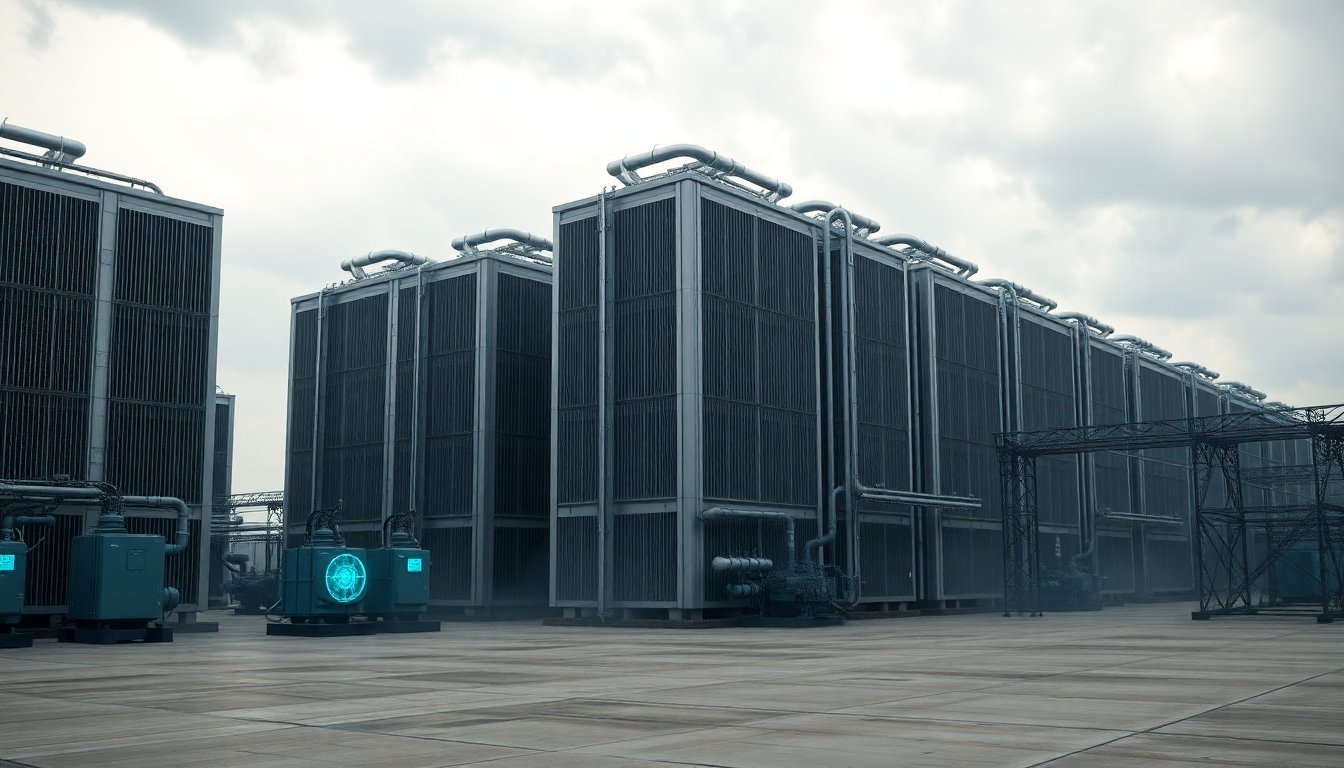
Data center power demand to quadruple by 2035, reshaping AI infrastructure
Data center electricity consumption is projected to quadruple by 2035, driven by AI workloads. This analysis examines which companies are positioned to win and lose in the coming energy crunch.
According to a TechCrunch AI report published July 21, 2026, new data centers built through 2033 alone could consume as much electricity as India uses today. This 4x surge in power demand by 2035 is not a hypothetical scenario—it is already reshaping investment strategies at Microsoft, Google, and Amazon.
- TechCrunch AI reported on July 21, 2026, that data centers built through 2033 could consume as much electricity as India uses today.
- The 4x increase in power demand by 2035 will force hyperscalers to secure dedicated energy sources or face operational bottlenecks.
- Microsoft and Google are already investing in nuclear and microgrid solutions, while smaller providers face cost and capacity risks.
Why are data centers projected to consume 4x more electricity by 2035?
According to TechCrunch AI, the explosive growth of AI workloads is the primary driver. Training large language models and running inference at scale require exponentially more compute than traditional cloud workloads. The report notes that new data centers built through 2033 could collectively draw power equivalent to India's current national consumption. This is not a distant forecast—it is a near-term reality that is already straining grid infrastructure in regions like Northern Virginia, where data center capacity has grown by over 40% since 2023.
The U.S. Energy Information Administration (EIA) corroborates this trend in its 2026 Annual Energy Outlook, projecting that data center electricity demand will grow at an average annual rate of 12% through 2035. This growth rate outpaces all other major industrial sectors, including manufacturing and transportation. The EIA attributes this acceleration to the deployment of advanced AI chips that, while more efficient per teraflop, are deployed in far greater numbers.
Which hyperscalers are best positioned to manage this energy surge?
Microsoft and Google are the clear frontrunners. Microsoft has signed multiple power purchase agreements (PPAs) totaling over 10 gigawatts of renewable energy capacity since 2024, and in 2026 it announced a partnership with Constellation Energy to explore small modular reactor (SMR) nuclear options for its data centers. Google, meanwhile, has committed to operating on 24/7 carbon-free energy by 2030 and has invested in enhanced geothermal systems and long-duration battery storage to complement its solar and wind assets.
Amazon Web Services (AWS) is also active but has taken a more distributed approach, building smaller data centers closer to renewable generation sources. However, according to the EIA, AWS's reliance on public grid interconnection for many of its existing facilities exposes it to higher risk of curtailment during peak demand events. This is a vulnerability that Microsoft and Google are actively mitigating through on-site generation investments.
| Factor | Microsoft | Amazon (AWS) | |
|---|---|---|---|
| On-site generation strategy | Nuclear SMR partnership with Constellation Energy | Enhanced geothermal, long-duration battery storage | Distributed renewables, grid interconnection focus |
| Renewable PPA capacity (2024-2026) | 10+ GW | 8+ GW | 12+ GW (but less on-site) |
| Grid dependency risk | Low (active hedging) | Low (24/7 CFE commitment) | Medium (higher interconnection reliance) |
| AI workload exposure | High (Copilot, Azure OpenAI) | High (Gemini, TPU clusters) | High (Bedrock, Trainium) |
| Verdict | Strongest | Strong | Moderate |
My thesis is clear: the coming energy crunch will separate the hyperscalers who secure dedicated power from those who depend on public grids. In the short term (2026-2028), I expect Microsoft and Google to maintain their growth trajectories because their energy strategies already hedge against rising electricity costs and potential grid constraints. The losers will be smaller colocation providers and AI startups that lack the capital to negotiate long-term PPAs or invest in on-site generation. By 2030, I predict we will see at least one major cloud provider announce a multi-gigawatt nuclear SMR project specifically for AI workloads, likely Microsoft or Google. This is not speculation—it is the logical next step given the EIA's demand projections and the TechCrunch AI report's framing of the scale involved.
What does this mean for AI startups and smaller cloud providers?
The implications are stark. According to the TechCrunch AI report, the 4x increase in electricity consumption will drive up wholesale power prices in data center-heavy regions. For AI startups that rely on third-party colocation or smaller cloud providers, this means higher operational costs and potential capacity shortages. I anticipate a consolidation wave where cash-rich hyperscalers acquire or partner with energy developers, while smaller players are priced out of prime locations.
How will regulators respond to this energy demand?
Regulatory responses are still forming, but the EIA's data suggests that grid operators in regions like PJM (covering 13 mid-Atlantic states) are already updating interconnection queues to prioritize data center projects that include on-site generation or storage. I expect the Federal Energy Regulatory Commission (FERC) to issue new guidelines by 2028 that require large data center operators to submit integrated resource plans demonstrating how they will manage peak demand without straining local grids. This will further advantage hyperscalers with dedicated energy portfolios.
Predictions
- Microsoft will announce a 1+ GW nuclear SMR project dedicated to its AI data centers by Q2 2028.
- The EU AI Office will require data centers over 100 MW to source at least 50% of their electricity from on-site generation or dedicated PPAs by 2030.
- At least one major colocation provider (e.g., Equinix or Digital Realty) will be acquired by a hyperscaler or energy company by 2029 to secure capacity.
Article Summary
- The 4x electricity demand increase by 2035 is driven by AI workloads and is already reshaping hyperscaler energy strategies.
- Microsoft and Google are best positioned due to on-site generation and nuclear investments; AWS faces higher grid dependency risk.
- Smaller providers and AI startups will face cost and capacity pressures, driving consolidation.
- Regulatory changes favoring on-site generation will further entrench hyperscaler advantages.
- Nuclear SMRs and dedicated microgrids are the most likely near-term solutions for the largest operators.

Source and attribution
TechCrunch AI
Data centers expected to use 4x more electricity by 2035




Discussion
Add a comment