
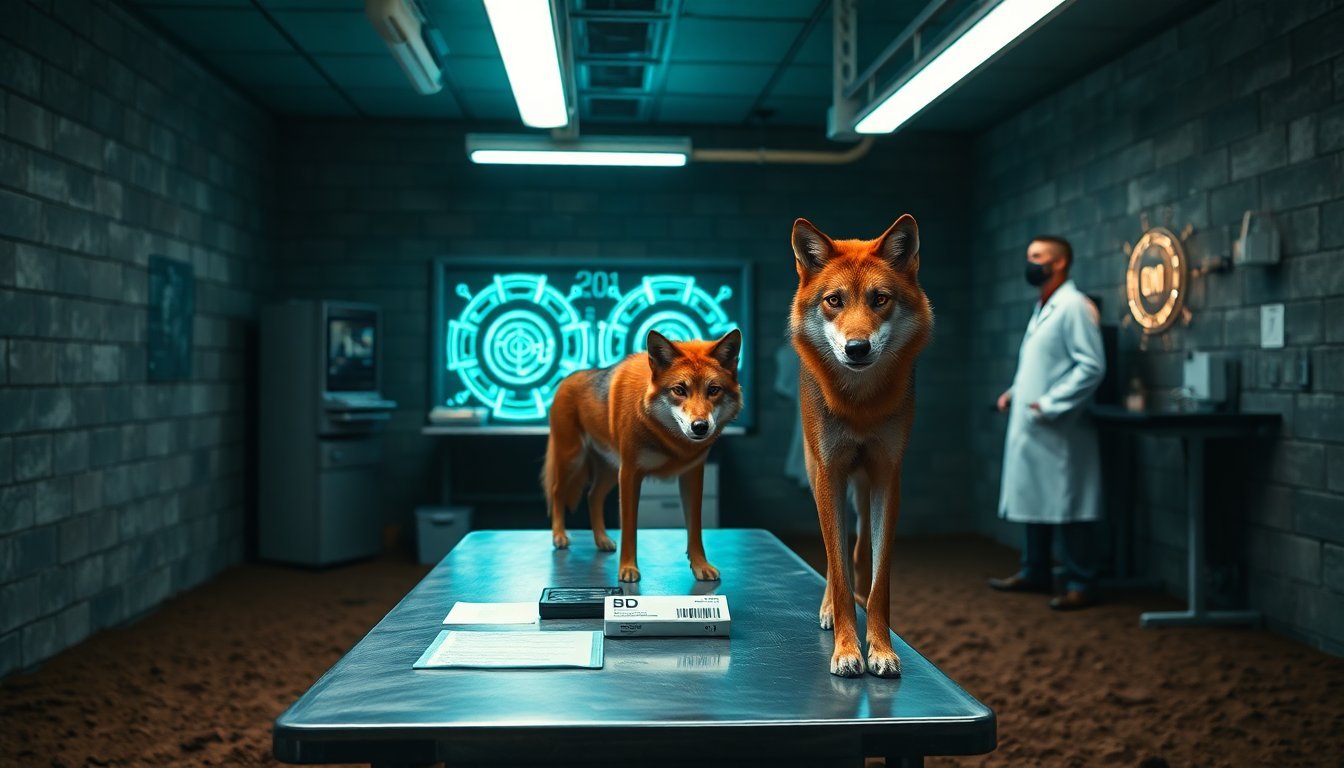
Colossal's Red Wolf Clones: Real Science or Conservation Theater?
Colossal Biosciences announced it has cloned red wolves, a critically endangered species with fewer than 20 wild individuals. While the technical achievement is real, the conservation value remains unproven until the clones survive, breed, and reintegrate into wild populations.
On a foggy January morning outside Houston, two young scientists from Colossal Biosciences drove into the mist to meet animals that shouldn't exist: red wolves cloned from frozen cells. The company claims these are the first red wolf clones ever produced, but the real question isn't whether the cloning worked — it's whether these animals can save a species that's already functionally extinct in the wild.
- Colossal Biosciences cloned red wolves from cryopreserved cells, a technical first for this critically endangered species.
- The announcement comes as the US Fish and Wildlife Service reports fewer than 20 red wolves remain in the wild, making cloning a potential lifeline — or a distraction.
- The real test isn't the cloning itself but whether these animals can survive captivity, breed successfully, and eventually be reintroduced into managed wild habitats.
Did Colossal Actually Clone Red Wolves, or Is This a Stunt?
According to MIT Technology Review, Colossal Biosciences produced red wolf clones from cryopreserved somatic cells, using the same somatic cell nuclear transfer technique that created Dolly the sheep. The January field visit described in the report shows two young scientists, including Tanner Broussard, caring for the animals in a Houston-area facility. The clones are genetically identical to a male red wolf whose cells were banked decades ago, giving conservationists a genetic rescue option that didn't exist before. The technical details matter here. Colossal said the cloning succeeded on the first attempts, which would be remarkable given that red wolves have never been cloned before. But MIT Technology Review reported that the company has not yet published peer-reviewed data on the clones' health, fertility, or behavioral development. Without that evidence, the announcement is a claim, not a proven result.
Why Are Red Wolves in Such Dire Straits That Cloning Seems Necessary?
According to the US Fish and Wildlife Service's Red Wolf Recovery Program, the wild population has collapsed from a peak of 120 animals in 2012 to fewer than 20 today. The species was declared extinct in the wild in 1980, then reintroduced in eastern North Carolina in 1987. But gunshot mortality, vehicle strikes, and hybridization with coyotes have decimated the population. The agency reported that only 13 known wild red wolves were confirmed in 2025, making every individual genetically precious. This is where cloning becomes more than a novelty. The captive population of roughly 250 red wolves is genetically bottlenecked, with many animals sharing recent ancestors. A clone derived from a genetically valuable historical individual could inject new diversity into the breeding pool. That's the argument Colossal is making: not that clones will replace wild wolves, but that they'll strengthen the captive population enough to make reintroduction viable again.What Does the US Fish and Wildlife Service Actually Think About This?
The US Fish and Wildlife Service has not endorsed Colossal's cloning program. The agency's Red Wolf Recovery Plan, updated in 2023, focuses on habitat protection, coyote sterilization, and community engagement — not on cloning. The service said in its 2025 status report that genetic rescue through assisted reproduction is a "potential tool," but the agency hasn't committed to accepting clones into its managed breeding program. This is a critical gap. Colossal can clone wolves, but it cannot release them into the wild without federal approval. The species is protected under the Endangered Species Act, and any reintroduction requires a formal plan. According to MIT Technology Review, Colossal has not yet submitted a proposal to the Fish and Wildlife Service for integrating clones into the recovery program. That means the clones are currently a scientific demonstration, not a conservation intervention.How Do Colossal's Clones Compare to Traditional Red Wolf Recovery Efforts?
| Approach | Cost per Animal | Time to Wild Release | Genetic Diversity Impact | Proven Success |
|---|---|---|---|---|
| Colossal Cloning | High (est. $500K+) | 3-5 years minimum | High potential, unproven | None in red wolves |
| Captive Breeding | Moderate | 1-3 years | Limited by existing gene pool | Proven but insufficient |
| Wild Population Management | Low per animal | Immediate | Preserves existing diversity | Partially successful until 2012 |
| Verdict | Cloning adds genetic value but cannot replace habitat protection and anti-poaching enforcement. The US Fish and Wildlife Service's traditional recovery tools remain the only proven path to wild population recovery. | |||
What Would Have to Happen for These Clones to Actually Matter?
For Colossal's red wolf clones to contribute to conservation, three things must happen in sequence. First, the clones must reach sexual maturity and breed successfully with non-cloned wolves, proving they're not just viable but fertile. Second, the US Fish and Wildlife Service must accept the offspring into its Species Survival Plan, which requires genetic screening and health certifications. Third, the resulting animals must survive in a managed wild setting, which means the agency must designate new reintroduction sites — a politically fraught process. MIT Technology Review's field report shows the clones are healthy at several months old, but that's the easy part. Red wolves in captivity live 12-14 years, and no one has yet demonstrated that a cloned canid can navigate the social complexities of wolf pack life. The company would need to show that its clones can form pair bonds, raise pups, and avoid inbreeding with close relatives — behaviors that emerge over years, not months.My thesis is that Colossal's red wolf cloning is real science wrapped in premature victory laps. The company has achieved something technically impressive — cloning a critically endangered canid from frozen cells — but it has not yet demonstrated conservation value. The distinction matters because Colossal's business model depends on investors believing that de-extinction is not just possible but imminent.
In the short term, this announcement is a win for Colossal's fundraising narrative. The company has raised over $500 million to date, and every successful cloning announcement — the dingo, the black-footed ferret, now the red wolf — extends its runway. But in the long term, the red wolf program could become an albatross. If the clones fail to breed, or if the Fish and Wildlife Service declines to integrate them, Colossal will have spent millions producing animals with no conservation outcome.
The biggest winner here is the broader de-extinction field, which gains another proof point that cloning endangered species is technically feasible. The biggest loser is the US Fish and Wildlife Service's traditional recovery program, which will now face pressure to incorporate unproven genetic interventions into a plan that's already struggling. The agency's leadership has been cautious, but political pressure from Congress and conservation donors could force the issue.
I predict that within 18 months, Colossal will announce that one of its red wolf clones has produced a pregnancy — but that the resulting pup will not be released to the wild. The company will cite regulatory delays, which will be real, but the deeper reason will be that the Fish and Wildlife Service is not yet convinced the clones are genetically or behaviorally suitable for release.
My Predictions for Colossal's Red Wolf Program
1. By December 2027, Colossal Biosciences will announce a successful pregnancy from a cloned red wolf female, but the offspring will remain in captivity due to unspecified "regulatory requirements." 2. The US Fish and Wildlife Service will not formally integrate cloned red wolves into its Species Survival Plan before 2028, citing insufficient peer-reviewed data on long-term health and behavior. 3. Colossal will pivot its red wolf program toward "genetic rescue" of captive populations rather than wild reintroduction, acknowledging that habitat loss and poaching remain the binding constraints.- January 2026Clones born
Colossal Biosciences produces red wolf clones at a Houston-area facility, first reported by MIT Technology Review.
- April 2026Public announcement
MIT Technology Review publishes a field report on the clones, confirming their existence and current health.
- 2027 (expected)Sexual maturity
Clones reach breeding age; Colossal will need to demonstrate successful reproduction to validate conservation claims.
- 2028 (projected)Potential FWS decision
US Fish and Wildlife Service may decide whether to accept clones into its Species Survival Plan, pending peer-reviewed data.
- Cloning red wolves is technically real, but conservation value is unproven until the animals breed and survive in managed wild settings.
- The US Fish and Wildlife Service has not endorsed cloning, creating a regulatory bottleneck Colossal must navigate.
- Colossal's business model depends on continuous cloning announcements, which risks prioritizing publicity over ecological outcomes.
- The red wolf's crisis is fundamentally a habitat and human-conflict problem; genetics alone cannot solve it.
- Watch for Colossal's next announcement: a pregnancy from a clone, which would be the first real test of conservation viability.

Source and attribution
MIT Technology Review
Colossal Biosciences said it cloned red wolves. Is it for real?





Discussion
Add a comment