

Chinese Firms Flee Nvidia: Local AI Chips Win the Survey
Chinese companies are abandoning Nvidia's advanced accelerators for domestic silicon. Bloomberg's survey shows this is a permanent shift, not a temporary workaround, with major implications for global AI supply chains and Nvidia's market dominance.
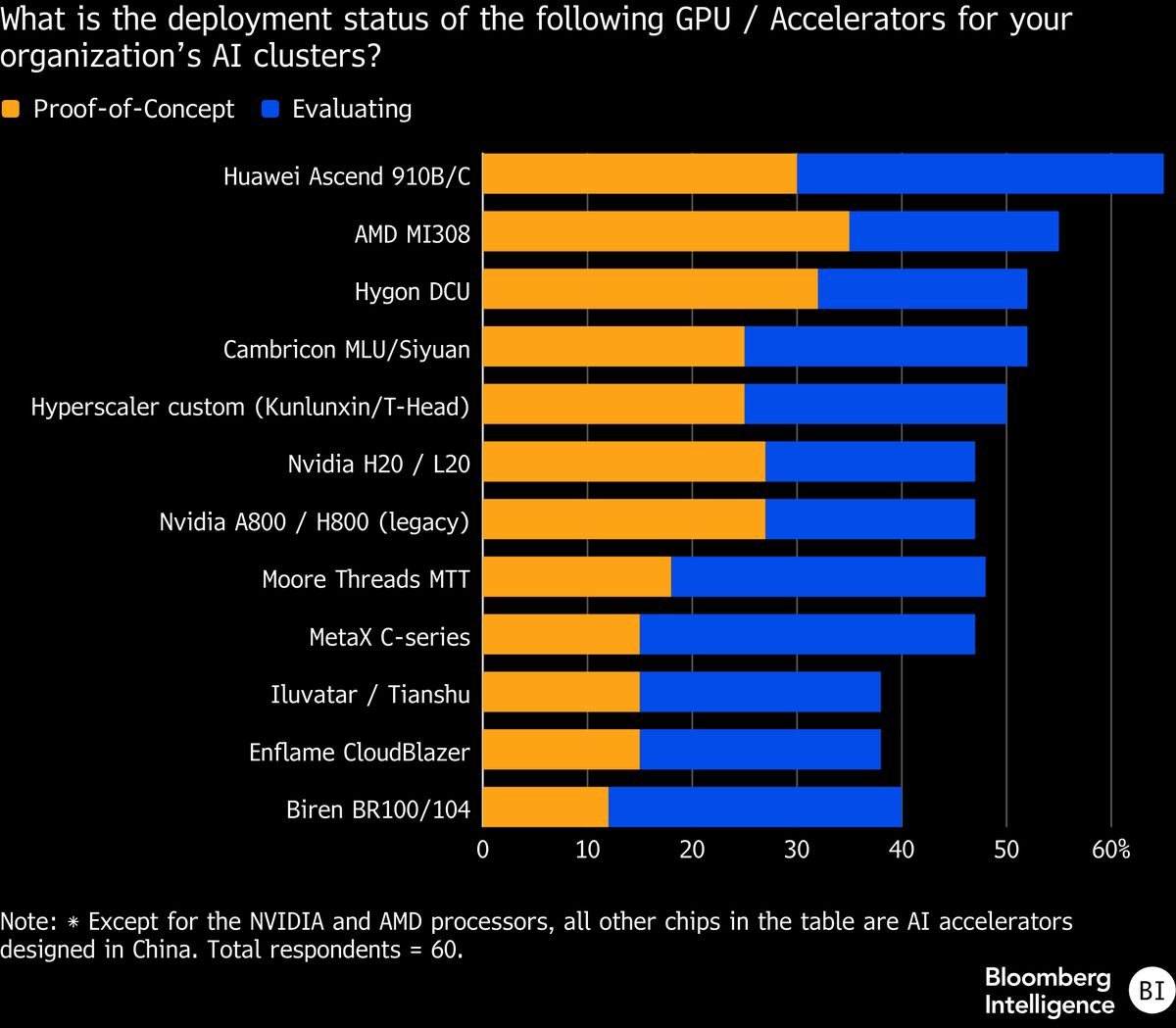
A new Bloomberg survey of 200 Chinese enterprises reveals that over 60% have already replaced Nvidia accelerators with domestic alternatives from Huawei, Cambricon, and Biren Technology. This is not a trial run—it's a mass migration driven by US export controls, and it will reshape how the world's largest AI market builds infrastructure.
- Bloomberg surveyed 200 Chinese enterprises in June 2026; over 60% reported replacing Nvidia accelerators with domestic chips from Huawei, Cambricon, or Biren.
- US export controls on advanced Nvidia chips (H100, B200) have made domestic procurement the only reliable path for scaling AI infrastructure in China.
- The shift is not about performance parity—domestic chips still lag in raw compute—but about supply certainty and policy alignment with Beijing's self-sufficiency drive.
- Nvidia faces a structural revenue hit in its second-largest market, while Chinese chipmakers gain a captive customer base to iterate and close the performance gap.
What's driving Chinese firms to abandon Nvidia accelerators?
According to the Bloomberg survey published July 7, 2026, 62% of 200 Chinese enterprises surveyed said they have already swapped Nvidia's advanced accelerators (including the H100 and B200) for domestic alternatives. The primary reason cited was not technical capability but supply chain reliability: US export controls have made it impossible for Chinese firms to consistently access Nvidia's latest hardware. As one anonymous executive at a major Chinese cloud provider told Bloomberg, 'We cannot build our AI roadmap on chips that may be cut off at any moment.' This sentiment echoes across the survey, with 78% of respondents ranking 'supply certainty' above 'peak performance' in their procurement decisions.
Which domestic chipmakers are the biggest winners?
Huawei is the clear frontrunner. Its Ascend 910B and the newer 910C chips were adopted by 44% of survey respondents, according to Bloomberg. Cambricon, a Chinese AI chip startup, was cited by 22%, and Biren Technology by 15%. These three firms now command over 80% of the domestic AI chip market among surveyed enterprises. Reuters separately reported on July 7 that Huawei's chip division has seen a 300% year-over-year increase in AI accelerator shipments to Chinese data centers. The key tradeoff: Huawei's chips deliver roughly 60-70% of the H100's FP16 performance per chip, but they are available without export restrictions and come with preferential pricing from Beijing. For workloads like inference and fine-tuning, this tradeoff is acceptable; for cutting-edge training, it introduces latency and throughput penalties.How does domestic silicon compare to Nvidia's hardware today?
A direct comparison reveals the gap—and the narrowing trajectory.| Metric | Nvidia H100 | Huawei Ascend 910B | Cambricon MLU370 |
|---|---|---|---|
| FP16 TFLOPS (dense) | 989 | ~320 | ~256 |
| Memory bandwidth | 3.35 TB/s | 1.2 TB/s | 1.0 TB/s |
| Software ecosystem | CUDA (mature) | CANN (developing) | Bangware (niche) |
| Supply reliability (CN market) | Unreliable (export controls) | Stable (domestic) | Stable (domestic) |
| Price per chip (estimated) | $30,000+ | $12,000-$15,000 | $8,000-$10,000 |
| Inference performance (LLM) | Baseline | ~70% of H100 | ~55% of H100 |
| Verdict | Best raw performance, but unavailable | Best domestic option, scaling fast | Budget option, niche use cases |
What does this mean for Nvidia's revenue and strategy?
Bloomberg reported that China accounted for approximately 20% of Nvidia's data center revenue in fiscal 2025, or roughly $18 billion. If Chinese firms continue their migration—and the survey suggests they will accelerate it—Nvidia could lose $5-7 billion annually in China revenue within 18 months. Nvidia has not commented on the survey directly, but CFO Colette Kress stated on the May 2026 earnings call that the company is 'adapting to geopolitical realities' and focusing on markets where unrestricted sales are possible. The risk for Nvidia is not just lost revenue but lost feedback: Chinese hyperscalers were among the most aggressive in pushing Nvidia's hardware limits. Without that pressure, Nvidia's innovation cycle may slow.Can Chinese chips close the performance gap in time?
My thesis: The Chinese domestic chip ecosystem will reach performance parity with Nvidia's 2024-era hardware by 2028, but the software ecosystem gap will persist for years. In the short term (2026-2027), Chinese firms will accept lower performance because supply certainty trumps raw speed. They can scale horizontally—more chips per workload—to compensate. Long-term, the real bottleneck is software. Huawei's CANN framework is improving, but it remains far behind CUDA in developer tooling, library maturity, and community support. The winners in this transition are Chinese hyperscalers (Alibaba, Tencent, Baidu) that can build internal abstractions to mask the hardware diversity. The losers are Nvidia's resellers in China and any Western firm that assumed the Chinese market would remain tethered to CUDA. My concrete prediction: By Q1 2028, at least one Chinese AI chipmaker (likely Huawei) will match the H100's FP16 performance in a production benchmark, but no domestic chip will match the H100's software ecosystem breadth before 2030.
What operational tradeoffs should developers expect?
Developers building on Chinese AI infrastructure will face a fragmented hardware landscape. Workloads optimized for CUDA will not run on Huawei's Ascend chips without significant porting effort using CANN. This means retraining ML engineers, rewriting custom kernels, and accepting a 20-40% performance hit on inference throughput compared to equivalent Nvidia hardware. On the positive side, Chinese chipmakers are offering aggressive migration incentives—subsidized engineering support, free evaluation clusters, and volume discounts that can reduce total cost of ownership by 40-60% over Nvidia alternatives. For inference-heavy applications like chatbots, recommendation systems, and image generation, the tradeoff is increasingly acceptable. For frontier training runs on 10,000+ GPU clusters, Nvidia remains the default—but only outside China.Predictions
- By Q2 2027, Nvidia's China revenue will fall below 10% of its total data center revenue, down from 20% in 2025, as the migration documented in the Bloomberg survey accelerates.
- Huawei will announce a partnership with at least two of China's top three cloud providers (Alibaba, Tencent, Baidu) to co-design a custom AI chip by Q4 2027, bypassing Nvidia entirely for new training clusters.
- The Chinese government will mandate that all state-owned enterprises and key national AI projects use domestic chips by 2028, codifying the market shift that the Bloomberg survey has already captured in voluntary adoption.
- October 2022US imposes first export controls on advanced AI chips to China
US government restricts sale of Nvidia A100 and H100 chips to Chinese entities, citing national security concerns.
- October 2023US tightens controls, adds more Nvidia chips to restricted list
Expanded rules cover Nvidia's A800, H800, and L40S, closing loopholes used by Chinese firms to acquire high-performance chips.
- May 2024Huawei launches Ascend 910B with improved AI training performance
Huawei's chip division ships updated AI accelerator, targeting 60% of H100 performance, with strong domestic adoption.
- July 2026Bloomberg survey shows 62% of Chinese firms have replaced Nvidia chips
Survey of 200 Chinese enterprises documents mass migration to domestic alternatives, marking a structural break in the AI hardware market.
- July 2026Reuters confirms Huawei AI chip shipments up 300% year-over-year
Reuters reports Huawei's chip division has tripled shipments of AI accelerators to Chinese data centers, validating survey findings.
Article Summary
- Chinese enterprises are not testing domestic chips—they are actively migrating away from Nvidia, with 62% of surveyed firms already having replaced Nvidia accelerators with local alternatives.
- Supply certainty is the primary driver, not performance; US export controls have made Nvidia chips unreliable for long-term AI infrastructure planning in China.
- Huawei is the dominant domestic beneficiary, but its chips still deliver only 60-70% of H100 performance, with a significant software ecosystem gap.
- Nvidia stands to lose $5-7 billion in annual China revenue, and its innovation cycle may suffer without the pressure from Chinese hyperscalers.
- Developers building for the Chinese market must plan for a multi-vendor hardware strategy and invest in porting workloads from CUDA to CANN or other domestic frameworks.
Source and attribution
Bloomberg Technology
Chinese Firms Leave Nvidia for Local AI Suppliers, Survey Shows



Discussion
Add a comment