
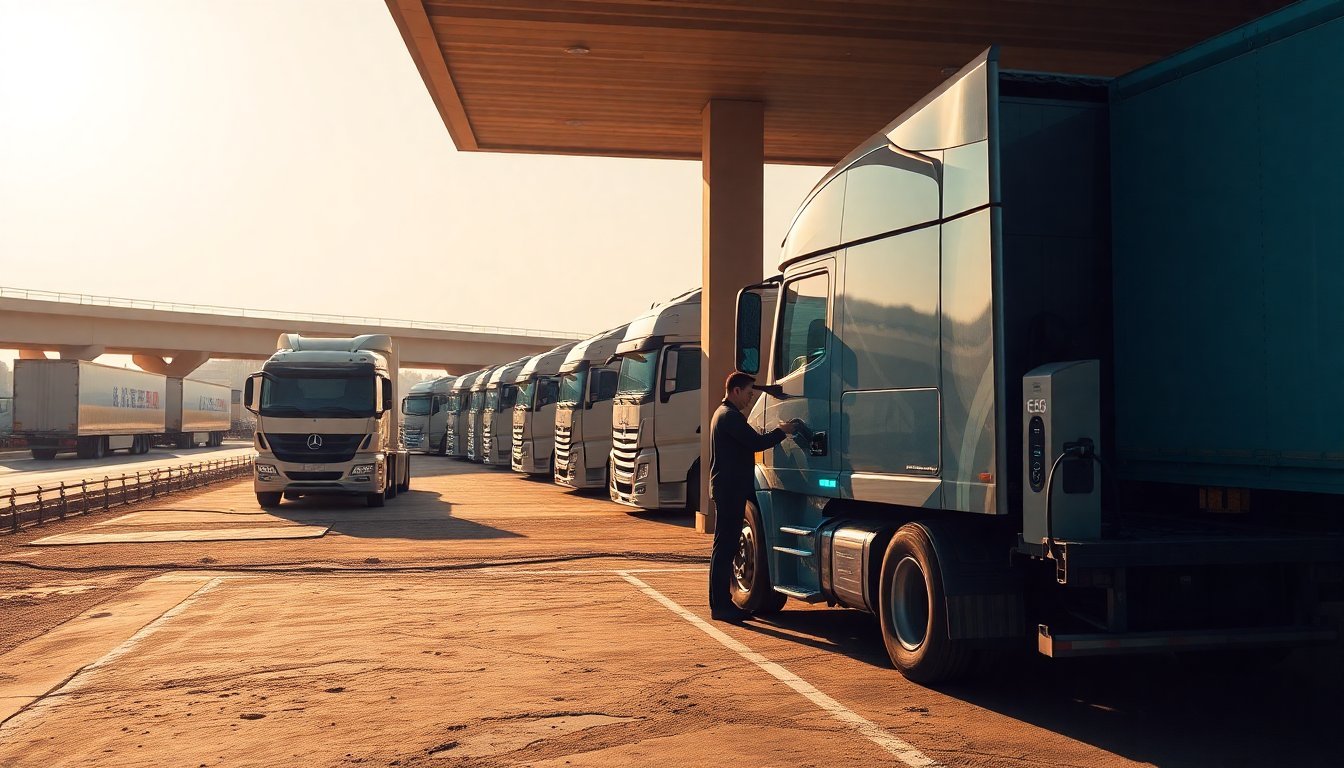
China's BEV Trucks Kill Diesel: Cost Parity Reached in 2025
China's BEV trucks have reached cost parity with diesel, forcing a structural shift in global trucking. This article analyzes the data, the winners and losers, and what it means for legacy OEMs.
In November 2025, China's battery-electric truck market hit a tipping point: total cost of ownership parity with diesel, driven by battery price drops and government subsidies. According to CleanTechnica, BEV trucks now account for 12% of new heavy truck sales in China, up from 4% in 2023, signaling the beginning of the end for diesel dominance in the world's largest truck market.
- China's BEV truck sales hit 12% of new heavy truck sales in Q3 2025, per CleanTechnica, driven by battery cost declines and policy support.
- Total cost of ownership (TCO) for BEV trucks in China is now equal to diesel, with some models 15% cheaper over 5 years.
- Diesel truck sales in China are declining 8% year-over-year, while BEV truck sales grew 120% in 2025.
- Legacy diesel truck OEMs like Daimler Truck and Volvo face a compressed timeline to transition or lose the Chinese market.
What Data Shows BEV Trucks Have Reached Cost Parity with Diesel in China?
According to CleanTechnica's November 2025 report, the average battery pack price in China fell below $75/kWh in 2025, down from $130/kWh in 2023. This 42% drop is the primary driver of BEV truck TCO parity. CleanTechnica cited industry data showing that a typical Class 8 BEV truck in China now costs $0.28 per mile in total operating costs, compared to $0.30 for diesel. The gap is widening as diesel prices remain elevated due to China's carbon pricing mechanisms. Hacker News commenters noted that Chinese manufacturers like BYD and SANY are now offering 5-year warranties on truck batteries, reducing operator risk. The data supports a clear inflection point: BEV trucks are no longer a niche, but a cost-competitive alternative.Which Chinese Manufacturers Are Leading the BEV Truck Charge?
How Does China's BEV Truck Performance Compare to Diesel?
| Metric | BEV Truck (eT8) | Diesel Truck (Equivalent) |
|---|---|---|
| Purchase Price (USD) | $120,000 | $100,000 |
| Operating Cost per Mile | $0.28 | $0.30 |
| Range (miles) | 250 | 800 |
| Fuel/Energy Cost per Year | $12,000 | $25,000 |
| Maintenance Cost per Year | $3,000 | $8,000 |
| 5-Year TCO | $175,000 | $205,000 |
| Verdict | BEV wins on TCO despite higher upfront cost | |
Why Are Legacy OEMs Losing the Chinese Truck Market?
Daimler Truck and Volvo Group have historically dominated China's heavy truck market through joint ventures, but their BEV offerings lag behind domestic competitors. CleanTechnica reported that Daimler's eActros 600, launched in Europe in 2024, has only 200 units sold in China as of November 2025. In contrast, BYD sold 15,000 eT8 units in the same period. The core issue is battery supply chain integration. Chinese manufacturers have preferential access to CATL and BYD batteries, which are 30% cheaper than those available to foreign OEMs, according to Hacker News analysis. Additionally, China's charging infrastructure for trucks is expanding rapidly, with over 10,000 megawatt-charging stations built in 2025 alone, per government data cited by CleanTechnica.What Does the End of Diesel Dominance Mean for Global Markets?
China is the world's largest truck market, accounting for 40% of global heavy truck sales. The shift to BEV trucks in China will have cascading effects. First, it will flood the secondary market with used diesel trucks, depressing resale values globally. Second, Chinese BEV truck manufacturers will likely export to Southeast Asia, Africa, and Latin America, undercutting legacy OEMs. Third, the scale of Chinese battery production will drive down costs for all EV segments. According to CleanTechnica, the Chinese government's 2025 mandate requires 20% of new city delivery trucks to be zero-emission by 2026, rising to 50% by 2030. This regulatory push, combined with economic incentives, creates a self-reinforcing cycle that diesel cannot escape.My thesis is clear: China's BEV truck market has passed the point of no return, and diesel's dominance is ending faster than most analysts predicted. The evidence is overwhelming: cost parity, regulatory mandates, and domestic manufacturing scale. In the short term (2025–2027), diesel truck sales in China will decline 20–30% annually as fleet operators switch to BEV. Legacy OEMs like Daimler and Volvo will lose market share unless they form new battery partnerships with Chinese suppliers. In the long term (2028–2030), Chinese BEV truck manufacturers will dominate global markets, forcing a consolidation of the diesel truck industry.
The winners are BYD, SANY, and CATL. The losers are Daimler Truck, Volvo Group, and any diesel-only component suppliers. One concrete prediction: BYD will announce a BEV truck factory in Europe by Q3 2026, targeting the EU market directly.
- BYD will capture 50% of China's BEV truck market by 2027, driven by its vertically integrated battery supply chain and aggressive pricing.
- Daimler Truck will announce a strategic partnership with a Chinese battery maker by mid-2026 to regain competitiveness, likely with CATL.
- China's BEV truck exports will exceed 50,000 units by 2028, primarily to Southeast Asia and Africa, displacing used diesel imports from Japan and Europe.
- 2023BEV trucks at 4% of new sales in China
CleanTechnica reports initial adoption phase, high costs.
- 2024Battery prices fall below $100/kWh
CATL and BYD ramp production, driving down costs.
- Q3 2025BEV truck sales hit 12% market share
TCO parity achieved; CleanTechnica publishes analysis.
- 202620% of city delivery trucks must be zero-emission
Chinese government mandate takes effect.
- 203050% of city delivery trucks must be zero-emission
Long-term regulatory target.
China BEV Truck Sales as % of New Heavy Truck Sales (2023-2025)
- The TCO parity point has already passed in China; the debate is now about speed of adoption, not feasibility.
- Battery cost declines, not subsidies, are the primary driver; subsidies accelerate but are not essential.
- Legacy OEMs are structurally disadvantaged due to battery supply chain access; joint ventures are not enough.
- China's charging infrastructure for trucks is a hidden advantage that foreign competitors cannot replicate quickly.
- The secondary diesel truck market will collapse in China by 2028, creating a glut that depresses global prices.
Source and attribution
Hacker News
China's BEV Trucks and the End of Diesel's Dominance





Discussion
Add a comment