

CARE: The First Systematic Methodology for Engineering LLM Agents
CARE provides a structured workflow for engineering LLM agents in scientific domains, replacing ad-hoc approaches with reusable artifacts and stage-gated phases. The methodology empowers SMEs while reducing developer burden, but raises questions about helper agent reliability.
The paper from arXiv introduces Collaborative Agent Reasoning Engineering (CARE), a three-party design methodology involving Subject-Matter Experts (SMEs), developers, and LLM-based helper agents. Unlike ad-hoc trial-and-error, CARE specifies behavior, grounding, tool orchestration, and verification through reusable artifacts and systematic, stage-gated phases.
- CARE introduces a three-party workflow (SMEs, developers, LLM helper agents) for systematic agent engineering.
- It replaces ad-hoc trial-and-error with reusable artifacts and stage-gated phases.
- The methodology focuses on scientific domains but could generalize to other knowledge-intensive fields.
- Helper agents may introduce their own brittleness, requiring careful validation.
What Makes CARE Different from Existing Agent Engineering Approaches?
According to the authors of the CARE paper on arXiv, the methodology is designed to address the "ad-hoc trial-and-error approaches" that currently dominate LLM agent development. They argue that without systematic processes, agent behavior becomes unpredictable and hard to validate. CARE specifies behavior through reusable artifacts—structured documents that define agent reasoning, tool usage, and verification criteria. The methodology proceeds through stage-gated phases, meaning each phase must be approved before moving to the next. This contrasts with the common practice of iterating prompts until they happen to work.
From my analysis, this is a significant departure from how most teams build agents today. The majority of agent engineering is still a craft: developers tweak prompts, observe outputs, and tweak again. CARE formalizes this into a repeatable process, which is essential for production deployments where consistency matters more than creativity.
Who Are the Three Parties and What Roles Do They Play?
The three-party workflow is the core innovation. Subject-Matter Experts (SMEs) define the domain knowledge, validation criteria, and acceptable outputs. Developers implement tool orchestration, connect APIs, and manage the technical stack. LLM-based helper agents act as facilitators—they generate candidate artifacts, suggest refinements, and check consistency. According to the paper, these helper agents "function as facilitators" that bridge the gap between domain expertise and technical implementation.
This tripartite structure is clever because it acknowledges that no single group can build effective agents alone. SMEs lack technical depth, developers lack domain expertise, and helper agents lack both—but together they can produce agents that are both accurate and functional. However, the helper agents are themselves LLMs, which means they bring their own failure modes: hallucinations, bias, and inconsistency. The paper does not fully address how to validate helper agent outputs before they influence the design.
What Are the Reusable Artifacts and Stage-Gated Phases?
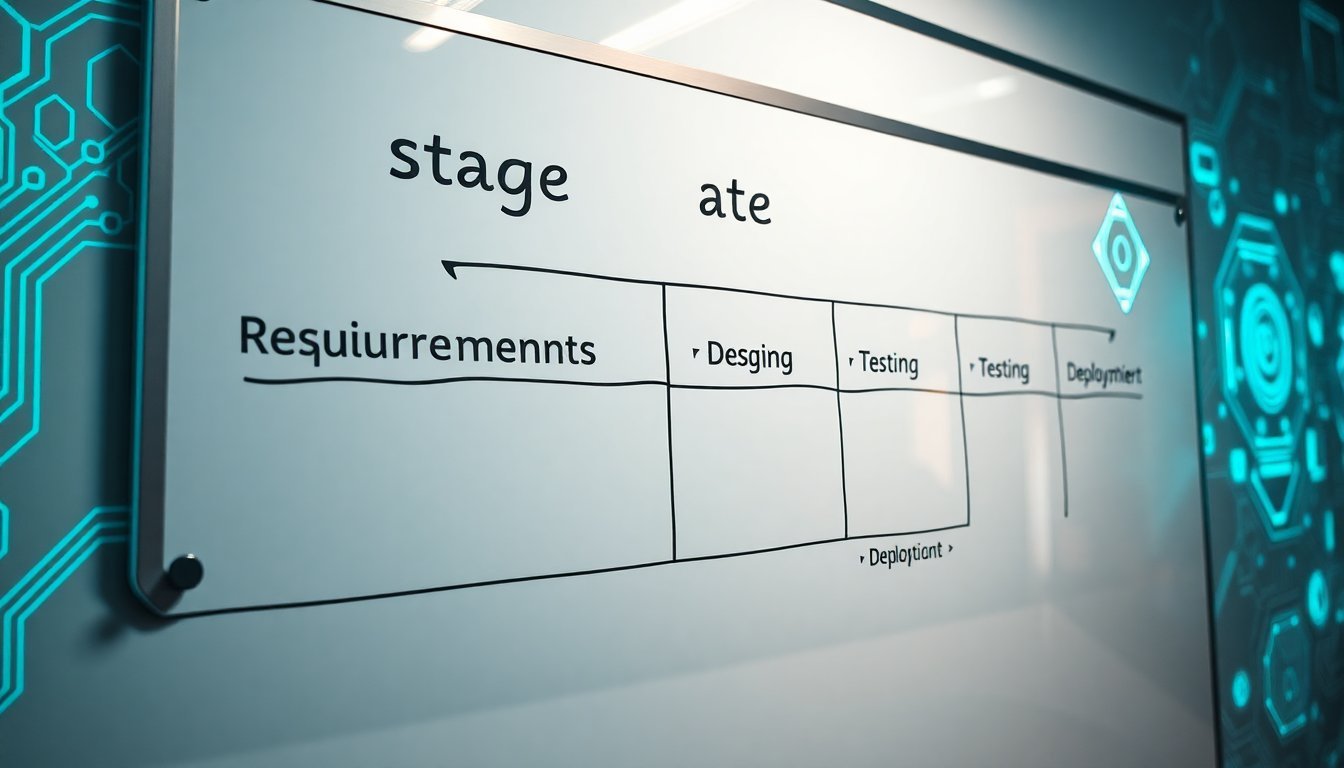
CARE defines several artifact types: behavior specifications, grounding documents, tool orchestration diagrams, and verification checklists. Each artifact is versioned and reviewed at stage gates. The phases include: requirement analysis, design, implementation, testing, and deployment. At each gate, the three parties must sign off before proceeding. This borrows from traditional software engineering methodologies like Waterfall or V-Model, but adapted for the probabilistic nature of LLMs.
I see this as both a strength and a weakness. The structure ensures rigor, but it may slow down rapid prototyping. For teams that need to iterate quickly, CARE might feel bureaucratic. The paper acknowledges this tension but does not provide guidance on when to skip or compress phases.
How Does CARE Compare to Other Agent Engineering Approaches?
| Feature | CARE | Ad-hoc Prompt Engineering | AutoGPT-style Agents |
|---|---|---|---|
| Structured phases | Yes, stage-gated | No | No |
| Reusable artifacts | Yes | No | No |
| Three-party workflow | Yes | No | No |
| Helper agents | Yes, LLM-based | No | Self-directed |
| Validation focus | Explicit verification | Implicit by testing | Minimal |
| Adoption barrier | Medium (requires process change) | Low | Low |
| Verdict | Best for production scientific agents | Best for quick experiments | Best for autonomous tasks |
What Are the Limitations and Risks of CARE?
The paper is honest about its limitations. The methodology has been tested only in synthetic scientific scenarios, not in real-world deployments. The helper agents, being LLMs, can produce plausible but incorrect artifacts. The stage-gated process assumes that SMEs and developers have the time and willingness to participate in multiple review cycles. According to the paper, "future work should evaluate CARE in real-world settings."
From my perspective, the biggest risk is that teams adopt CARE as a silver bullet without understanding the underlying assumptions. Helper agents are not neutral—they encode biases from their training data. If a helper agent suggests a behavior specification that subtly favors one scientific hypothesis over another, it could skew results. The paper does not discuss bias mitigation strategies.
My thesis: CARE is a necessary step toward professionalizing agent engineering, but its success hinges on whether the helper agents can be made trustworthy. In the short term, early adopters will be research labs that already use structured methodologies. They will find CARE useful for documenting and replicating agent designs. In the long term, if helper agents become reliable enough, CARE could become the standard for scientific agent development. The winners are SMEs who gain control over agent behavior without needing to code. The losers are prompt engineers who rely on ad-hoc skills. I predict that within 18 months, at least one major cloud provider (AWS, Google, or Azure) will offer a CARE-compatible agent engineering service, integrating helper agents as a managed feature.
What Should Teams Do to Prepare for CARE?
Teams that want to adopt CARE should start by training SMEs and developers on the artifact types and phase gates. The paper provides templates for behavior specifications and verification checklists. Teams should also evaluate helper agent reliability before relying on them for critical design decisions. A pilot project with a low-stakes agent is recommended. Finally, teams should plan for iteration—CARE is not a one-pass methodology.
I believe that CARE will eventually be absorbed into larger agent development platforms. The concepts are sound, but the manual process described in the paper will likely be automated. The real value of CARE is in the mindset shift: from ad-hoc tinkering to systematic engineering.
Predictions
- Within 12 months, at least one peer-reviewed paper will use CARE to produce a scientific agent, demonstrating its practical value.
- Within 18 months, a major cloud provider (AWS, Google, or Azure) will announce a CARE-compatible agent engineering service.
- Within 24 months, CARE artifacts will be standardized as part of an open-source framework, reducing adoption barriers.
Article Summary
- CARE introduces a structured, three-party methodology that replaces ad-hoc agent engineering with reusable artifacts and stage-gated phases.
- The methodology empowers SMEs while reducing developer burden, but helper agents introduce their own risks.
- CARE is best suited for production scientific agents; teams should pilot it before full adoption.
- The methodology's long-term success depends on helper agent reliability and platform integration.





Discussion
Add a comment