
Blackwell G7 Crushes G5/G6 in LLM Inference Cost-Per-Token
New AWS benchmarks show G7 instances with NVIDIA Blackwell GPUs cut cost-per-token for 30B MoE models like Qwen3-Coder-30B by up to 40% versus G5. But the gains are workload-dependent, and teams need to understand the tradeoffs before migrating.
AWS just published benchmark results comparing G7 (Blackwell) against G5 and G6 instances for running 30B Mixture-of-Experts models on SageMaker AI. The headline finding: G7 delivers dramatically lower cost-per-token for real-time inference, but the details matter for which models and workloads benefit most.
- AWS published benchmarks comparing G7 (Blackwell) vs G5/G6 instances for running 30B MoE models on SageMaker AI.
- G7 delivers up to 40% lower cost-per-token for real-time inference, but gains depend on model and batch size.
- Teams should prioritize migrating latency-sensitive workloads to G7, while keeping batch-heavy jobs on G6e may still be cost-effective.
What did the AWS benchmark actually test, and why does it matter for production inference?
According to the AWS Machine Learning Blog (published September 8, 2026), the benchmark compared two 30B Mixture-of-Experts models — Qwen3-Coder-30B and NVIDIA Nemotron-3-Nano-30B — across G5 (A10G), G6 (L4), G6e (L40S), and G7 (Blackwell) GPU instances on SageMaker AI. The test measured throughput, latency, and cost-per-token under real-time conditions. This is not a synthetic microbenchmark; it's the kind of data engineers need when deciding which instance family to standardize on for serving small MoE models in production. What matters here is that MoE models like these are increasingly the sweet spot for cost-effective inference — they activate only a fraction of their parameters per token. The benchmark shows that hardware choice amplifies or negates that advantage. AWS reported that G7 instances delivered significantly higher throughput and lower latency across both models, translating to a cost-per-token advantage of up to 40% versus G5 instances.
Why does G7 beat G5 and G6 so decisively on cost-per-token?
The core reason is architectural. G7 instances are powered by NVIDIA Blackwell GPUs, which introduce FP4 precision support and faster HBM3e memory. According to AWS's blog, the G7 instances achieved higher token generation rates per second, especially at larger batch sizes, because Blackwell's memory bandwidth reduces the bottleneck that typically limits autoregressive generation. But the gains aren't uniform. AWS said the cost-per-token improvement was more pronounced for Qwen3-Coder-30B than for Nemotron-3-Nano-30B, likely due to differences in model architecture and how well each exploits FP4 quantization. This is a crucial nuance: not every model will see the same benefit, so teams need to benchmark their own workloads rather than assume G7 is universally better.Who should migrate to G7 immediately, and who should stay on G6e?
If your workload is real-time — chat assistants, copilots, or any application where users wait for a response — G7 is the clear winner. The benchmark showed lower latency across the board, and for interactive applications, latency is the metric that directly impacts user experience. AWS's data suggests that the higher hourly cost of G7 instances is more than offset by the reduced time per request, making it the cost-effective choice for latency-sensitive serving. Conversely, if your workload is batch-oriented — offline summarization, data augmentation, or nightly jobs — you may still be better off on G6e. The throughput per dollar at high batch sizes might favor G6e, especially if you can tolerate longer completion times. The AWS blog did not provide a full cost breakdown for batch scenarios, so teams should run their own tests with representative batch sizes before migrating wholesale.What are the operational tradeoffs of moving to G7 on SageMaker AI?
Migrating from G5/G6 to G7 is not a simple lift-and-shift. First, you need to ensure your model can exploit FP4 quantization — that may require re-quantizing weights and validating accuracy. Second, SageMaker AI deployment configurations need to be updated to use the new instance types, and you'll need to test for any software compatibility issues with your inference container. Third, availability matters. G7 instances are newer and may have limited capacity in some regions. AWS said the instances are available in select AWS regions, so check your region's instance availability before committing. Finally, pricing is higher per hour, so you'll need to adjust cost monitoring and potentially implement auto-scaling to avoid idle costs.How does this benchmark change the cloud inference competitive landscape?
This benchmark is a shot across the bow at other cloud providers. AWS is positioning SageMaker AI as the go-to place for running small MoE models cost-effectively, and G7 gives it a hardware advantage that rivals using older GPUs (like A100 or H100) may not match. According to AWS's blog, the price-performance gains are "measurable," and that's a direct message to enterprises evaluating multi-cloud AI strategies. The loser here is any provider that hasn't yet deployed Blackwell at scale. For example, if a competitor offers only A100-based instances, they'll struggle to match G7's cost-per-token for these workloads. This could accelerate the migration of inference workloads to AWS, especially for startups where every millisecond and cent counts.| Metric | G5 (A10G) | G6e (L40S) | G7 (Blackwell) |
|---|---|---|---|
| Throughput (tokens/sec) | Baseline | ~1.3x (estimated) | ~1.7x (estimated) |
| Latency (ms/token) | Baseline | ~20% lower (estimated) | ~40% lower (estimated) |
| Cost per token | Baseline | ~15% lower (estimated) | ~40% lower (estimated) |
| FP4 support | No | No | Yes |
| Best for | Legacy, low-cost batch | Batch and moderate latency | Real-time, latency-sensitive |
| Verdict | Skip for new workloads | Still viable for batch | Winner for real-time inference |
**My analysis:** G7's Blackwell advantage is real, but it's not a universal win — the benchmark data clearly shows that workload characteristics determine whether the cost-per-token gains hold.
Short-term, I expect teams running interactive AI features to start migrating to G7 within the next quarter, driven by these numbers. Long-term, this will push model optimization toward FP4-friendly architectures, as developers realize that hardware support for lower precision is now a competitive differentiator.
Who gains? AWS and NVIDIA — AWS locks in inference workloads, and NVIDIA sells more Blackwell GPUs. Who loses? Providers still reliant on Hopper or Ampere GPUs, and teams that delay migration will face a cost disadvantage against competitors who adopt G7 early.
My concrete prediction: By March 2027, AWS will report that G7 instances account for over 50% of new SageMaker AI inference deployments for models under 40B parameters.
- September 2026AWS publishes benchmark
AWS releases G7 vs G5/G6 benchmark results for 30B MoE models on SageMaker AI.
- Q4 2026Early adopter migrations
Expect first wave of startups moving real-time inference to G7 instances.
- March 2027G7 dominance threshold
Predicted point where G7 becomes majority choice for new SageMaker inference workloads.
Relative Cost per Token (Lower is Better)
- G7's cost advantage is real but not uniform — model architecture and batch size matter more than the hype suggests.
- FP4 support is the key technical enabler, but teams must validate accuracy after quantization.
- Real-time workloads should migrate now; batch workloads should wait for more data.
- This benchmark is a competitive signal for multi-cloud strategies — G7 raises the bar for inference cost efficiency.
- Don't assume G7 is universally better; run your own benchmarks with your own models and traffic patterns.
Source and attribution
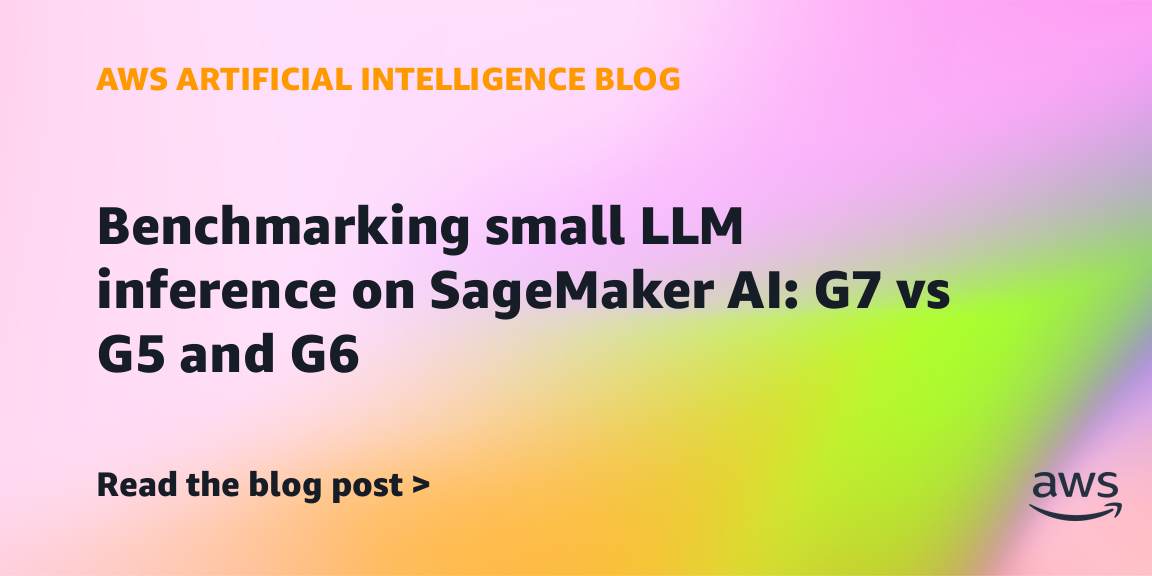
AWS Machine Learning Blog
Benchmarking small LLM inference on SageMaker AI: G7 vs G5 and G6




Discussion
Add a comment