

BAS Metric Will Expose Which LLMs Are Actually Safe to Use
The Behavioral Alignment Score framework evaluates LLMs based on how well their confidence aligns with optimal abstention decisions under different risk scenarios. This exposes a fundamental flaw in current evaluation methods that reward confident generation regardless of correctness, creating immediate pressure on providers whose models can't reliably know when they don't know.
Researchers from undisclosed institutions have introduced the Behavioral Alignment Score (BAS), a decision-theoretic framework for evaluating when LLMs should answer versus abstain. This isn't another accuracy benchmark—it's a direct challenge to the entire premise that models should always generate responses, and it arrives just as enterprises are demanding reliable AI for high-stakes decisions.
- Researchers introduced the Behavioral Alignment Score (BAS), a decision-theoretic metric that evaluates LLM confidence for abstention-aware decision making rather than raw accuracy.
- This matters because current benchmarks force models to answer every question, rewarding confident hallucinations in low-stakes academic tests while ignoring real-world scenarios where "I don't know" is the correct response.
- The key tension is between academic research focused on capability metrics and enterprise needs for reliable, calibrated AI that understands its own limitations in production environments.
- BAS represents the first framework that explicitly connects model confidence to economic decision-making under different risk preferences, creating a bridge between ML research and business utility.
Why Do Current LLM Benchmarks Fail Real-World Decision Makers?
Current evaluation protocols like MMLU, HellaSwag, and TruthfulQA require models to produce an answer for every question, creating what the BAS paper calls "a perverse incentive" for confident generation regardless of correctness. According to the arXiv paper published April 3, 2026, these benchmarks measure capability in artificial test environments but ignore how confidence should guide the fundamental decision of whether to answer at all. This creates models optimized for academic leaderboards rather than business decisions—a dangerous mismatch when those same models get deployed in medical, legal, or financial contexts where wrong answers have real consequences. The research community has been chasing higher scores on these flawed metrics while enterprise buyers have been left with no standardized way to compare models on their actual utility for decision support.How Does BAS Actually Work to Measure Decision Utility?
BAS frames the LLM evaluation problem as a decision under uncertainty: given a confidence score and a user's risk preference, should the model answer or abstain? The framework, detailed in the April 2026 arXiv paper, derives from an explicit answer-or-abstain decision rule that maximizes expected utility across different risk profiles. Unlike accuracy metrics that treat all questions equally, BAS incorporates the economic reality that some mistakes are costlier than others—a medical diagnosis error carries different weight than a trivia mistake. The metric evaluates how well a model's confidence scores align with optimal abstention decisions across the full spectrum of risk aversion, from risk-neutral to highly risk-averse users. This creates a single score that captures whether a model knows what it knows, which is fundamentally different from whether it knows facts.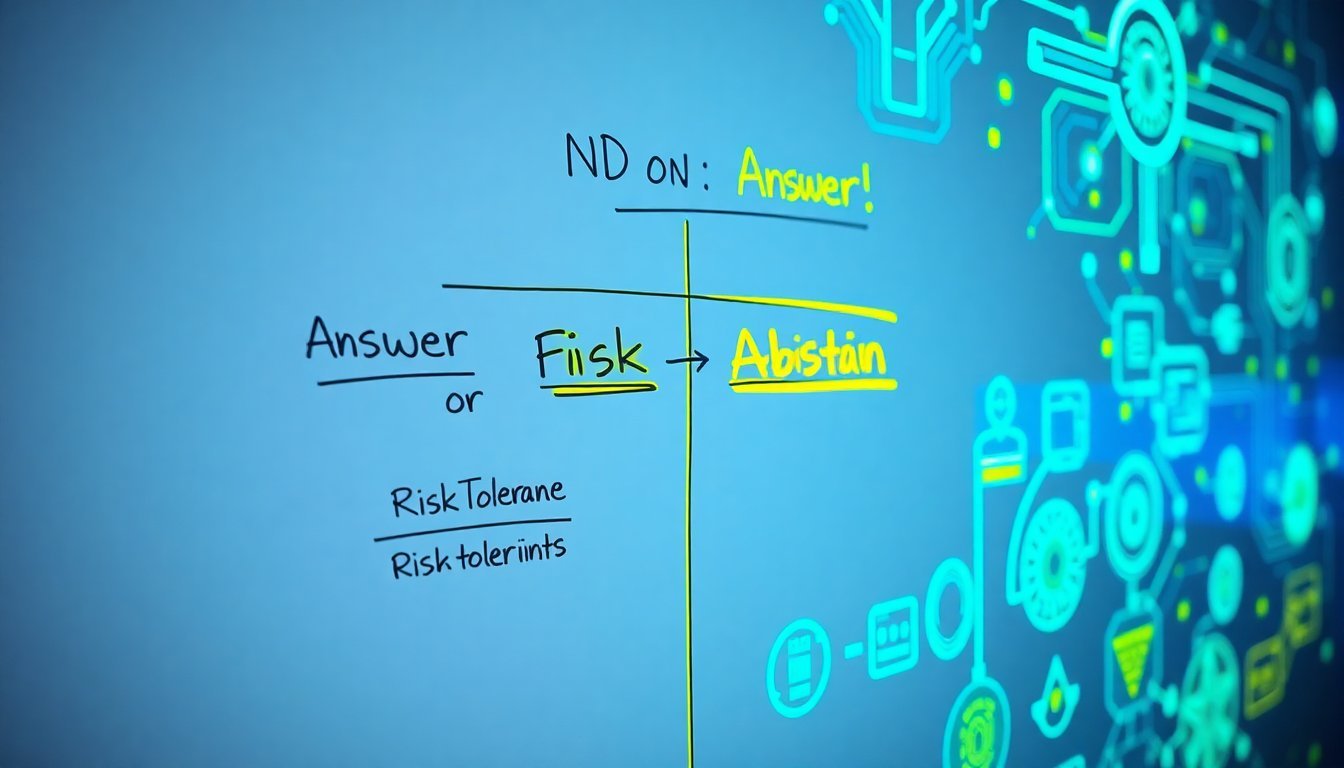
Which Companies Will BAS Expose as Confidence Frauds?
BAS creates immediate transparency problems for companies whose business models depend on models that always generate responses. Consumer chatbots like ChatGPT and Claude that prioritize engagement over accuracy will show poor BAS scores because their confidence calibration isn't optimized for high-stakes abstention decisions. Coding assistants like GitHub Copilot that generate plausible-but-wrong code without adequate uncertainty signaling will face particular scrutiny, as their errors propagate through production systems. The framework reveals which providers have invested in proper confidence calibration versus those who have treated uncertainty as an afterthought. Companies like OpenAI that have pushed capability frontiers while downplaying reliability concerns will face uncomfortable questions about whether their models are actually safe for enterprise deployment.How Will BAS Change Enterprise LLM Procurement Decisions?
Enterprise buyers currently evaluate models through demos and limited pilot projects that rarely test edge cases or measure confidence calibration systematically. BAS provides the first standardized framework for comparing models on their decision utility rather than their raw capability. According to the research, this will shift procurement criteria from "What accuracy does it achieve?" to "Under what risk conditions can I trust its answers?" Financial institutions evaluating loan approval systems, healthcare providers considering diagnostic assistants, and legal firms exploring research tools will all demand BAS scores alongside traditional accuracy metrics. This creates a competitive advantage for providers like Anthropic and Cohere that have emphasized safety and reliability from the beginning, while putting pressure on capability-first providers to retrofit confidence calibration into existing models.| Evaluation Approach | What It Measures | Business Relevance | Primary Beneficiaries |
|---|---|---|---|
| Traditional Accuracy Benchmarks (MMLU, etc.) | Raw capability on curated test sets | Low - measures academic performance, not decision utility | Research labs chasing leaderboard positions |
| Behavioral Alignment Score (BAS) | Confidence calibration for abstention decisions | High - directly measures real-world decision support value | Enterprise buyers, regulated industries |
| Human Evaluation Studies | Subjective quality assessments | Medium - expensive, non-scalable, prone to bias | Marketing departments, product demos |
| Production A/B Testing | Business outcomes in specific deployments | High but narrow - organization-specific, not comparable | Individual companies with deployment resources |
| Verdict | BAS wins for enterprise procurement - it provides standardized, decision-theoretic evaluation that traditional benchmarks lack while being scalable and comparable unlike human studies or A/B tests. | ||
BAS represents the most important shift in LLM evaluation since the creation of the original benchmarks, and I believe it will force a painful but necessary reckoning across the industry. My thesis is simple: models that can't reliably know when they don't know are fundamentally unsafe for enterprise deployment, and BAS provides the first rigorous framework to identify which providers have actually solved this problem versus those who have been optimizing for leaderboard vanity metrics.
In the short term, expect enterprise buyers to start demanding BAS scores in RFPs within 12 months, creating immediate pressure on providers to publish results or face exclusion from serious procurement processes. Companies like Anthropic that have built their brand around reliability will benefit disproportionately, while consumer-focused chatbots will need to either develop enterprise-grade confidence calibration or accept their relegation to entertainment applications.
Long-term, BAS will accelerate the bifurcation of the LLM market into two distinct categories: high-reliability enterprise tools with proper uncertainty quantification, and entertainment-grade consumer products that prioritize engagement over accuracy. This is healthy for the industry but painful for companies caught in the middle. I expect Microsoft to be the first major cloud provider to integrate BAS evaluation into its Azure AI model catalog by Q4 2026, using it as a competitive differentiator against AWS and Google Cloud's more capability-focused offerings.
The biggest losers will be startups that have built businesses on top of uncalibrated models, assuming that raw capability would be sufficient for enterprise adoption. The biggest winners will be enterprise buyers who finally get a standardized way to compare models on what actually matters for business decisions rather than academic exercises.
What Technical Changes Will BAS Force in Model Development?
BAS evaluation will redirect research and development efforts from pure capability enhancement to confidence calibration techniques. The April 2026 paper makes clear that current methods for generating confidence scores—often simple softmax probabilities over tokens—are inadequate for the abstention decisions that BAS evaluates. Companies will need to invest in proper uncertainty quantification methods, potentially including ensemble approaches, Bayesian neural networks, or dedicated confidence calibration training. This represents a significant shift in engineering priorities and compute allocation, moving resources from scaling parameters to improving calibration. The research community will need to develop new training techniques that optimize for BAS alongside traditional accuracy metrics, creating a more balanced development paradigm.Projected BAS Score Impact on Enterprise Adoption (Estimated)
Will BAS Become the Standard or Remain an Academic Curiosity?
Predictions- Microsoft will integrate BAS evaluation into Azure AI's model catalog by Q4 2026, using it as a key differentiator against AWS SageMaker and Google Vertex AI's more capability-focused offerings.
- The Financial Industry Regulatory Authority (FINRA) will reference BAS in its 2027 guidance on AI use in broker-dealer operations, creating de facto compliance requirements for financial services AI providers.
- Anthropic's Claude 4 will achieve the highest published BAS score among general-purpose models when evaluated in Q3 2026, validating its safety-first approach and accelerating enterprise adoption at the expense of capability-optimized competitors.
- BAS shifts LLM evaluation from academic accuracy contests to real-world decision utility, exposing which models are actually safe for enterprise deployment.
- Enterprise buyers will start demanding BAS scores in procurement processes within 12 months, creating immediate competitive pressure on providers.
- The framework accelerates market bifurcation into high-reliability enterprise tools and entertainment-grade consumer products.
- Microsoft is positioned to benefit most by integrating BAS into Azure AI as a competitive differentiator against capability-focused cloud rivals.
- Regulated industries will adopt BAS for compliance validation, making it a de facto standard for serious AI applications.
Source and attribution
arXiv
BAS: A Decision-Theoretic Approach to Evaluating Large Language Model Confidence






Discussion
Add a comment