

AWS's 82% Latency Cut Is a Shot at Nvidia's Volume Story
Amazon SageMaker HyperPod Inference Gateway routes inference requests using real-time GPU signals on EKS, claiming up to 82% first-token latency reduction without code changes. This analysis examines who wins, who loses, and what AWS is really signaling about GPU economics.
AWS just shipped a Kubernetes-native, GPU-aware routing add-on for Amazon EKS that it says cuts first-token latency by up to 82% — with no changes to model servers or client applications. The claim, published on the AWS Machine Learning Blog on September 18, 2026, is less about latency and more about who controls the inference layer.
- What happened: AWS launched SageMaker HyperPod Inference Gateway, a Kubernetes-native, GPU-aware routing add-on for Amazon EKS that uses real-time GPU signals to route inference requests.
- Why it matters: AWS claims up to 82% first-token latency reduction with zero changes to model servers or client applications — a rare no-friction upgrade pitch for enterprise AI infrastructure.
- The tension: If GPU-aware routing delivers on the 82% claim, it reduces the pressure to buy more GPUs — which is good for AWS customers and bad for Nvidia's volume narrative.
- What to watch: Whether the 82% figure survives third-party benchmarks, and whether Google Cloud and Azure ship equivalents before EKS clusters standardize on AWS's routing layer.
What Did AWS Actually Ship on September 18?
According to the AWS Machine Learning Blog, the SageMaker HyperPod Inference Gateway is a Kubernetes-native, GPU-aware routing add-on for Amazon EKS. The mechanism is specific: it reads real-time GPU signals and sends each inference request to the pod best suited to handle it. AWS states the result is up to 82% reduction in first-token latency, achieved without changes to model servers or client applications. That "no changes" clause is the part most analysts will skim past. It is also the most consequential. Enterprise inference stacks are notoriously brittle — swapping a router usually means touching serving frameworks, client SDKs, or both. AWS is explicitly promising the opposite. If that holds in production, the adoption curve is short.Why Does GPU-Aware Routing Beat Round-Robin?
Traditional Kubernetes ingress and service meshes route by network and pod health signals. They do not know whether a pod's GPU is saturated, memory-bound, or idle. AWS's pitch is essentially that routing decisions should be made on the resource that actually determines inference latency: the GPU. The 82% number, if accurate, implies that under naive routing a meaningful share of requests land on GPUs that are already busy — a known pathology in multi-tenant inference clusters. AWS did not publish the benchmark methodology in the summary, which is the first thing a skeptical buyer should demand. The claim is plausible; the magnitude is the open question.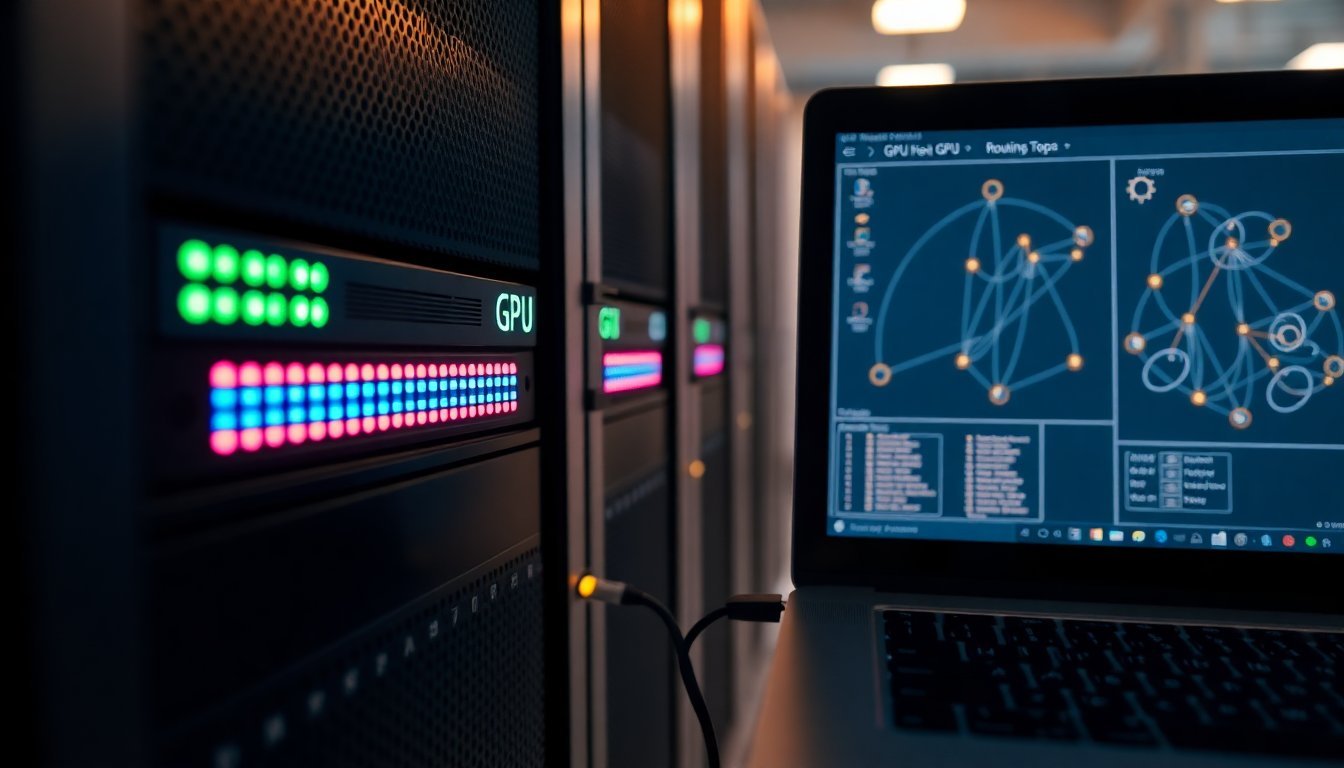
Who Wins and Who Loses From GPU-Aware Routing?
AWS wins on two fronts. First, it makes EKS stickier for AI workloads — once routing logic lives in AWS's gateway, migrating to GKE or AKS means rebuilding that layer. Second, it lets AWS market cost efficiency without discounting GPU hours, protecting margins. Nvidia is the quieter loser. Every percentage point of latency improvement from better routing is a percentage point of latency improvement that does not require buying another H100 or its successor. Nvidia's data center revenue story depends on utilization pressure, not just model growth. AWS did not frame this as an anti-Nvidia move, but the economics point that direction. Inference-serving startups — the BentoMLs, KServes, and Ray Serve ecosystems — face a harder pitch. Their core value proposition has been efficient routing and batching. AWS just bundled a credible version of that into a managed add-on.| Dimension | AWS HyperPod Inference Gateway | Self-managed K8s routing (Kserve, Ray Serve) | Google Cloud / Azure equivalents |
|---|---|---|---|
| GPU signal awareness | Native, real-time | Partial, requires custom work | Not publicly matched as of Sept 2026 |
| Client code changes | None claimed | Often required | Varies |
| Claimed latency gain | Up to 82% first-token | Benchmark-dependent | Unverified |
| Lock-in risk | Moderate to high (EKS-native) | Low | Moderate |
| Cost model | Managed add-on | Engineering time | Managed add-on |
| Verdict | Wins on adoption speed if 82% holds | Wins on portability | Losing until they ship parity |
Is the 82% Claim Defensible Without Published Methodology?
The AWS Machine Learning Blog states the 82% figure but, in the material provided, does not include benchmark configuration, model size, concurrency level, or baseline routing method. That is a gap, not a scandal — vendor launch posts routinely lead with best-case numbers. But it matters because the entire competitive argument rests on this single figure. A reasonable reading: the 82% is likely a best-case scenario under high GPU contention with naive baseline routing. Real-world gains for well-tuned clusters will be smaller. AWS has not claimed otherwise, but buyers should treat the number as a ceiling, not an expectation.Thesis: AWS's GPU-aware routing gateway is less a latency product than a lock-in play that quietly weakens the case for buying more Nvidia GPUs.
In the short term, this is a straightforward win for EKS customers running inference at scale. Free latency reduction with no code changes is a rare thing in enterprise AI, and AWS knows it. The company is trading a feature for cluster stickiness — a trade it has made repeatedly and usually won.
In the long term, the more interesting consequence is philosophical: if routing intelligence can recover 80% of the value that would otherwise require additional hardware, the industry's default answer to latency problems — buy more GPUs — gets weaker. That is a slow-acting pressure on Nvidia's demand curve, not a cliff, but it compounds.
Who loses most acutely? Inference-serving startups whose differentiation was routing. They now compete with a managed AWS feature that requires zero integration work. Some will pivot to multi-cloud abstraction; others will get acquired.
Prediction: By Q2 2027, Google Cloud will announce a GPU-aware routing capability for GKE, explicitly positioned as a response to AWS's HyperPod Inference Gateway.
What Should Enterprise AI Teams Do This Quarter?
According to AWS, the gateway requires no changes to model servers or client applications — which means the cost of a pilot is low. Teams running inference on EKS should benchmark it against their current routing within 30 days, using their own traffic, not AWS's published numbers. Teams on GKE or AKS should wait, but should start modeling what an 82% first-token reduction would do to their unit economics. The bigger strategic question is whether to accept the lock-in. AWS's gateway makes EKS more valuable and migration more expensive in the same move. That is the deal being offered.Key Takeaways
- AWS's 82% first-token latency claim is unverified but directionally credible; treat it as a ceiling.
- The real product is EKS stickiness, not latency reduction.
- Nvidia's volume story faces slow, compounding pressure from software efficiency gains.
- Inference-serving startups must pivot or risk commoditization.
- Google Cloud and Azure have a parity gap that will be expensive to close.
Predictions:
- Google Cloud will ship a GPU-aware routing equivalent for GKE by Q2 2027.
- At least one major inference-serving startup (Kserve, BentoML, or similar) will be acquired by a cloud provider by end of 2027.
- AWS will publish detailed benchmark methodology for the 82% claim within 90 days of launch, under competitive pressure.
- September 2026AWS launches HyperPod Inference Gateway
AWS announces the Kubernetes-native, GPU-aware routing add-on for Amazon EKS with a claimed 82% first-token latency reduction.
- Q2 2027 (projected)Expected Google Cloud response
Google Cloud is expected to ship a GPU-aware routing equivalent for GKE in response to AWS's move.
- End of 2027 (projected)Consolidation in inference-serving tools
At least one inference-serving startup is expected to be acquired by a major cloud provider.
Claimed First-Token Latency Reduction by Routing Approach (estimated)
Source and attribution
AWS Machine Learning Blog
Introducing Amazon SageMaker HyperPod Inference Gateway




Discussion
Add a comment