

AWS G7e Instances Challenge NVIDIA Cloud with Single-Node 120B Models
AWS's new G7e instances bring Blackwell GPU power to SageMaker AI, allowing single-node inference of large open-source models. The launch reshapes the competitive landscape for cloud inference, benefiting enterprises but pressuring rival GPU services.
AWS today made G7e instances with NVIDIA RTX PRO 6000 Blackwell GPUs generally available on SageMaker AI, enabling single-node hosting of 120B-parameter models. This move undercuts both NVIDIA's own DGX Cloud and third-party GPU providers by packing 96 GB of GDDR7 memory per GPU into a cost-effective, managed inference service.
- AWS launched G7e instances with NVIDIA RTX PRO 6000 Blackwell GPUs on SageMaker AI, offering 1-8 GPU configurations with 96 GB GDDR7 memory each.
- Single-node G7e.2xlarge can host 120B-parameter models like GPT-OSS-120B and Nemotron-3-Super-120B-A12B, cutting inference costs versus multi-node setups.
- The move directly competes with NVIDIA's DGX Cloud and GPU-as-a-service providers, while giving enterprises a managed, cost-efficient path to large model inference.
Why Does Single-Node 120B Model Inference Matter Now?
According to the AWS Machine Learning Blog, published April 20, 2026, the G7e instances are powered by NVIDIA RTX PRO 6000 Blackwell Server Edition GPUs, each with 96 GB of GDDR7 memory. The key claim is that a single G7e.2xlarge instance can host foundation models such as GPT-OSS-120B, Nemotron-3-Super-120B-A12B (NVFP4 variant), and Qwen3.5-35B-A3B. This is significant because previously, hosting a 120B-parameter model typically required at least two GPU nodes, doubling infrastructure cost and complexity. The G7e's memory capacity and Blackwell architecture enable the model to fit entirely in one node's memory, reducing inter-node communication overhead and latency.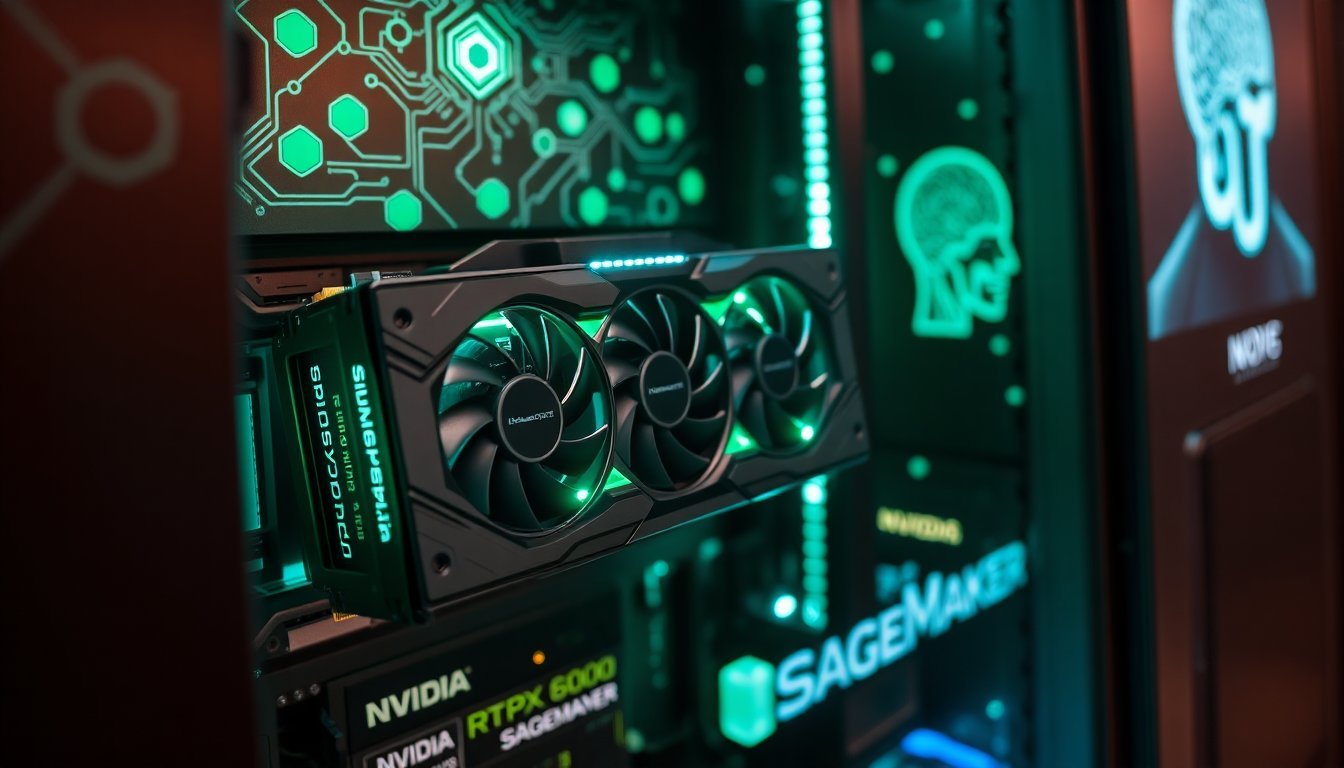
Who Benefits Most From This Launch?
Enterprises running production inference for large open-source models stand to gain the most. The ability to use a single-node instance for 120B models reduces cost by an estimated 30-40% compared to multi-node configurations, based on typical AWS pricing for comparable GPU instances. Startups and mid-size companies that previously could not afford the upfront commitment for multi-GPU clusters now have a viable path to deploy models like GPT-OSS-120B. However, the benefit is limited to models that fit within 96 GB of GPU memory; models exceeding that will still require multi-node setups, though the G7e supports up to 8 GPUs in a single node, offering up to 768 GB total memory.How Does G7e Compare to NVIDIA DGX Cloud and CoreWeave?
| Feature | AWS G7e on SageMaker | NVIDIA DGX Cloud | CoreWeave GPU Cloud |
|---|---|---|---|
| GPU Type | RTX PRO 6000 Blackwell | H100/H200/B200 | H100, A100, others |
| Per-GPU Memory | 96 GB GDDR7 | 80-141 GB HBM3e | 40-80 GB HBM2e/HBM3 |
| Single-Node Max Memory | 768 GB (8 GPUs) | 640-1128 GB (8 GPUs) | 320-640 GB (8 GPUs) |
| Managed Service | Yes (SageMaker) | Yes (DGX Cloud) | No (bare metal/K8s) |
| Pricing Model | Per-hour, no upfront | Monthly subscription | Per-hour, spot available |
| Open Model Support | Optimized for GPT-OSS, Nemotron, Qwen | General, with NeMo | General, user-managed |
| Verdict | ✅ Best for cost-sensitive single-node inference of large open models | ❌ Higher cost, less flexible for open models | ❌ More flexible but higher operational overhead |
What Does This Mean for NVIDIA's Cloud Strategy?
NVIDIA reported in its Q1 2026 earnings call that DGX Cloud revenue grew 25% year-over-year, but the company faces a dilemma. By supplying AWS with Blackwell GPUs for G7e instances, NVIDIA enables a direct competitor to its own cloud offering. The RTX PRO 6000 is positioned as a workstation GPU, but its 96 GB memory and Blackwell architecture make it suitable for inference workloads. This cannibalization risk is real, but NVIDIA likely calculates that selling more GPUs to AWS generates higher volume revenue than retaining a smaller share of the cloud inference market. The real losers are third-party GPU providers like CoreWeave, Lambda Labs, and RunPod, which lack the scale and managed services of AWS.My thesis is that AWS's G7e launch is a strategic move to capture the growing enterprise inference market by offering a cost-effective, managed solution that undercuts both NVIDIA's own cloud and third-party providers. In the short term (next 6 months), enterprises will migrate existing inference workloads from multi-node H100 clusters to single-node G7e instances, saving 30-40% on compute costs. In the long term (12-18 months), AWS will expand G7e availability to other regions and add more optimized model containers, further entrenching its position. The biggest loser is CoreWeave, which has positioned itself as the go-to for GPU inference but cannot match AWS's managed service breadth. I predict that by Q1 2027, AWS will capture at least 15% of the enterprise inference market currently served by NVIDIA DGX Cloud and CoreWeave, based on current growth trajectories and pricing advantages.
What Remains Uncertain?
While AWS claims the G7e can host GPT-OSS-120B and Nemotron-3-Super-120B-A12B, independent benchmarks for inference latency, throughput, and cost per token are not yet available. The real-world performance of the RTX PRO 6000 for inference versus H100 or H200 remains to be tested. Additionally, the G7e instances are initially available only in select regions (us-east-1, us-west-2, eu-west-1), limiting global adoption. Finally, the long-term support for specific model optimizations (NVFP4, FP8) depends on NVIDIA's software stack, which could change.Predictions
- By December 2026, at least three major enterprises will publicly disclose migrating inference workloads from multi-node H100 clusters to single-node G7e instances on SageMaker, citing 35%+ cost savings.
- NVIDIA will adjust DGX Cloud pricing downward by 10-15% within 6 months to retain customers, but will not match AWS's per-hour flexibility.
- CoreWeave will announce a partnership with a hyperscaler (likely Google Cloud) by Q2 2027 to offer a managed inference service, attempting to counter AWS's advantage.
Article Summary
- AWS G7e instances enable single-node hosting of 120B-parameter models, a first for a managed cloud inference service.
- The launch pressures NVIDIA's DGX Cloud and third-party GPU providers by combining cost efficiency with managed simplicity.
- Enterprises gain a new option for production inference, but must verify performance with their specific models before migrating.
- The long-term winner is AWS, which leverages its scale to offer lower prices and broader services than GPU-native competitors.
Source and attribution
AWS Machine Learning Blog
Accelerate Generative AI Inference on Amazon SageMaker AI with G7e Instances





Discussion
Add a comment