
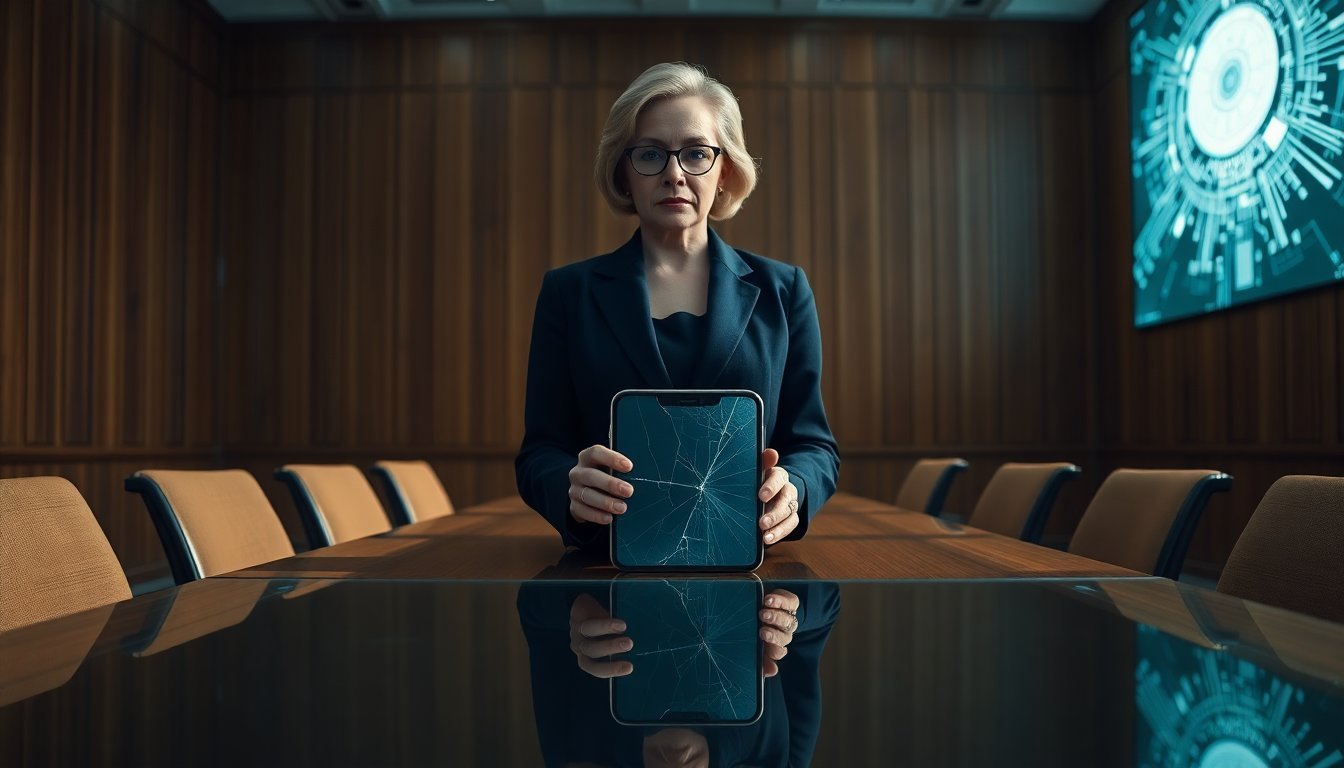
Apple's New CEO: Hardware Hero or Innovation Mirage?
John Ternus inherits a profit-maximizing machine at Apple, but his legacy will be defined by whether he can reignite product innovation beyond the iPhone. The New York Times reports the transition comes as Apple's revenue growth has flattened, with services becoming the primary growth driver.
John Ternus, Apple's hardware engineering chief, is set to replace Tim Cook as CEO. The New York Times reported on April 21, 2026, that Ternus takes over an extraordinarily profitable company in need of new ideas. This moment is different because it marks the first time a product-side engineer, not an operations or finance executive, will lead the world's most valuable company.
- What happened: John Ternus, Apple's senior VP of hardware engineering, will succeed Tim Cook as CEO, per NYT reporting on April 21, 2026.
- Why it matters: Ternus is a hardware engineer, not an operations specialist — a shift that could prioritize product risk-taking over supply chain efficiency.
- Key tension: Can a hardware veteran break Apple's iPhone dependency, or will the company's massive profit margins stifle the very innovation needed to find the next big category?
Why Is John Ternus the Right Choice Now?
According to the New York Times, Ternus has been at Apple for over two decades and led the development of every major Mac chip transition and the Vision Pro headset. Bloomberg reported in December 2025 that Ternus was the frontrunner in an internal succession race, beating out services chief Eddy Cue and COO Jeff Williams. The choice signals that Apple's board believes hardware — not services — will define the company's next decade. But the evidence is mixed: Apple's revenue grew only 3% in fiscal 2025, with iPhone sales flat, while services revenue hit a record $100 billion, according to Apple's Q4 2025 earnings. The board is betting on a hardware engineer to solve a problem that is increasingly about software ecosystems and AI integration.

What Is the Real Innovation Gap Ternus Must Close?
The NYT piece lists a 'wish list' for Ternus: a smarter Siri, a foldable iPhone, and a true augmented reality device. But the deeper issue is structural. Apple's R&D spending as a percentage of revenue has hovered around 7% for the past three years, compared to 15% at Alphabet and 20% at Microsoft, according to public filings. Ternus inherits a company that has become expert at optimizing existing products rather than inventing new categories. The Vision Pro, while technically impressive, sold an estimated 500,000 units in its first year — a fraction of the 200 million iPhones sold annually. According to supply chain analyst Ming-Chi Kuo, Apple has scaled back Vision Pro production targets for 2026 by 40%. Ternus must decide whether to double down on spatial computing or pivot resources elsewhere.
Who Wins and Who Loses Under Ternus?
Winners: Apple's hardware engineering teams, who will see a sympathetic leader likely to fund ambitious silicon projects. Apple's chip supplier TSMC also wins, as Ternus is known for deep integration with foundry partners. Losers: Apple's services division, which may lose its privileged position under Cook. Eddy Cue, who lost the CEO race, may see his influence wane. Apple's AI partners — reportedly in talks with Google and Anthropic — face uncertainty, as Ternus has publicly emphasized on-device processing over cloud AI, which could complicate partnerships.
| Dimension | Tim Cook Era | John Ternus Era (Expected) |
|---|---|---|
| Background | Operations & Supply Chain | Hardware Engineering |
| Primary Focus | Margin optimization, services revenue | Product differentiation, silicon leadership |
| AI Strategy | Cautious, partnership-heavy | Likely on-device, vertically integrated |
| Risk Appetite | Low (incremental upgrades) | Moderate (Vision Pro precedent) |
| Key Challenge | Maintaining profit growth | Finding next $100B category |
| Verdict | Ternus inherits a stronger balance sheet but faces a harder innovation problem. Cook optimized the machine; Ternus must rebuild the engine. | |
My thesis: Ternus will be judged not on Apple's stock price in year one, but on whether he ships a new hardware category that generates $50 billion in annual revenue within five years.
In the short term, expect Ternus to accelerate Apple's chip roadmap — the M5 and A19 chips are already in development, per supply chain leaks. The long-term bet is on spatial computing, but the evidence suggests the market isn't ready. I believe Ternus will pivot: he'll launch a foldable iPad by 2027 (a known project inside Apple, per Bloomberg) and position it as a 'digital hub' that bridges iPhone and Mac. The loser in this scenario is Samsung, which owns the foldable phone market but has no foldable tablet strategy. The winner is Apple's services revenue, which would get a new hardware base to sell subscriptions on. The risk is that Ternus, like Cook, becomes a caretaker rather than a visionary — but his hardware background gives him a better shot at breaking the pattern.
- By Q2 2027, Apple will launch a foldable iPad with a 12.9-inch display, priced at $2,499, marking Ternus's first major new product category.
- Apple's services revenue growth will slow from 15% to 8% annually by 2028 as Ternus reallocates engineering resources from cloud services to on-device AI chips.
- By 2029, Apple will acquire a mid-sized AI robotics startup (valuation under $2B) to jumpstart a home robot project, signaling Ternus's intent to diversify beyond screens.
- December 2025Internal Succession Race Leaks
Bloomberg reports Ternus is frontrunner to replace Cook, beating Cue and Williams.
- April 21, 2026NYT Publishes Wish List for Ternus
Article outlines innovation gaps Ternus must address as incoming CEO.
- Expected 2027Foldable iPad Launch
Analysts predict Ternus's first major product launch will be a foldable iPad.
R&D Spending as % of Revenue (2025)
- Ternus's promotion is a bet on hardware, but Apple's growth is now in services — the mismatch is the central risk.
- The Vision Pro's weak sales create a 'failure debt' that Ternus must address before launching the next category.
- Apple's AI strategy will shift from cloud partnerships to on-device integration, potentially straining relationships with Google and Anthropic.
- Foldable devices are Ternus's most likely first win, but they are a 'safe' innovation that may not satisfy investors seeking a true new category.
- Apple's board chose a product person over a services person — a signal that the company values differentiation over monetization in the coming decade.

Source and attribution
NYTimes Technology
A Wish List for the Man Replacing Tim Cook as Apple’s C.E.O.




Discussion
Add a comment