

Amazon FinTech Fixes Regulatory Hell with Bedrock RAG
Amazon Finance built a scalable AI application on Bedrock to handle regulatory inquiries. The key innovation is team-specific knowledge bases that keep sensitive documents isolated.
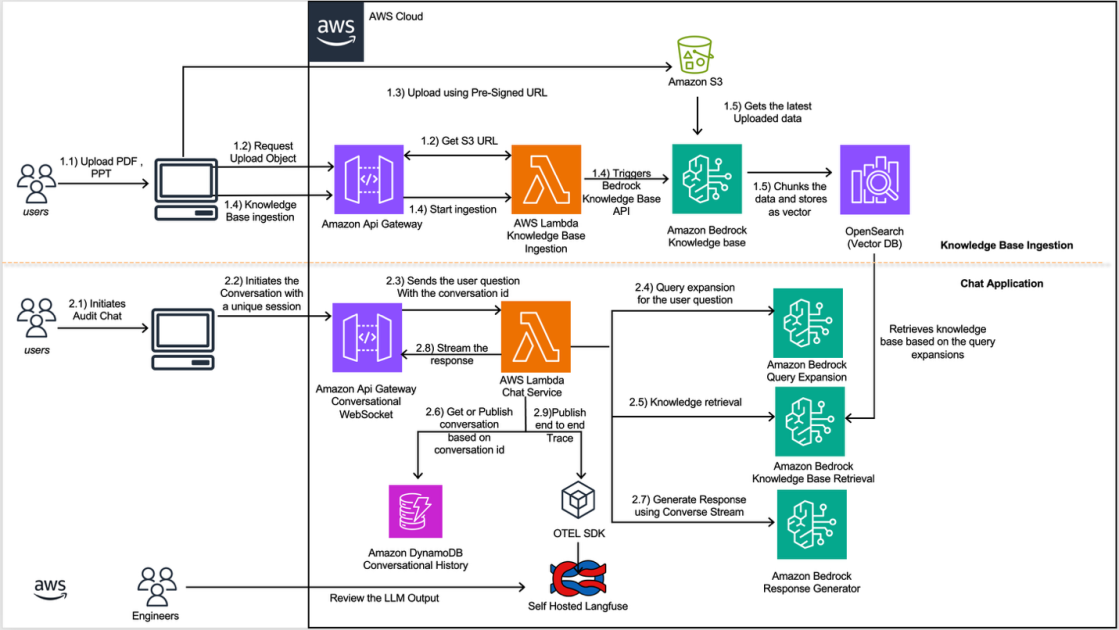
Amazon's own FinTech division has deployed a generative AI application on AWS Bedrock that automates responses to regulatory inquiries. According to the AWS Machine Learning Blog, each team maintains its own dedicated knowledge base, ensuring data stays within organizational boundaries.
- Amazon FinTech teams built a generative AI application on Amazon Bedrock to automate regulatory inquiry responses.
- Each team creates and maintains its own dedicated knowledge base, ensuring data sovereignty and compliance.
- The solution uses Retrieval-Augmented Generation (RAG) to ground responses in vetted documents, reducing hallucination risk.
How Does Amazon's RAG Architecture Keep Regulatory Data Secure?
According to the AWS Machine Learning Blog published on May 12, 2026, the application uses Amazon Bedrock with a RAG pattern. Each FinTech team maintains its own knowledge base populated with team-specific documents and reference materials. This design ensures that no team's regulatory data leaks into another's context window. The blog explicitly states that "each team using this solution creates and maintains its own dedicated knowledge base." This is a critical architectural choice: it avoids the common pitfall of a single, monolithic AI system that could expose sensitive financial data across departments.Why Did Amazon Choose Bedrock Over Building Custom Models?
Amazon's decision to use Bedrock rather than a custom-trained model is telling. The blog details that the solution leverages Bedrock's foundation models accessed via API, not fine-tuned models stored on-premises. This choice prioritizes speed of deployment and ease of updates over theoretical model control. According to the blog, the system "transforms how regulatory inquiries are handled" by providing a scalable, secure, and auditable response mechanism. The implication is clear: for enterprise compliance use cases, retrieval quality and data isolation matter more than model architecture.
What Makes Team-Specific Knowledge Bases a Game Changer?
The most innovative aspect is the per-team knowledge base. In most enterprise AI deployments, a centralized knowledge repository is used, creating a single point of failure and a massive data governance headache. Amazon's approach flips this: each team owns its data pipeline, document refresh cycle, and access controls. This mirrors microservices architecture—decentralized ownership reduces blast radius and accelerates iteration. The blog notes that this setup is "populated with that team's specific documents and reference materials," implying that teams can update their knowledge bases independently without affecting other teams' systems.Who Wins and Loses from This Deployment Model?
The clear winner is AWS, which now has a validated reference architecture for selling Bedrock into regulated industries like banking, insurance, and healthcare. The loser is any point-solution vendor offering a generic chatbot for regulatory compliance—Amazon's in-house build is both cheaper at scale and more secure by design. Companies like Casetext or Thomson Reuters, which offer domain-specific legal AI, may face pressure to prove their data isolation credentials match this standard. The blog's publication on the AWS Machine Learning Blog is itself a marketing move: it signals to enterprise CTOs that Amazon trusts its own AI for regulatory work.| Dimension | Amazon Bedrock RAG | Generic Chatbot Vendor |
|---|---|---|
| Data isolation | Per-team knowledge bases | Single tenant or shared |
| Model control | API access to foundation models | Often fine-tuned or custom |
| Deployment speed | Weeks (reference architecture) | Months (custom integration) |
| Auditability | Built-in via Bedrock logs | Depends on vendor |
| Cost at scale | Pay per token + storage | Per-seat license |
| Verdict | Winner: secure, scalable, fast | Loser: too generic for regulated use |
My analysis: This is not just a tech demo—it's a strategic signal. Amazon is telling every regulated enterprise: you can trust generative AI for compliance if you use our architecture. The short-term consequence is that AWS will win deals in financial services that previously went to specialized compliance software vendors. The long-term consequence is that the market for generic, non-domain-specific regulatory AI will shrink. The biggest loser is any vendor that cannot offer per-tenant knowledge base isolation out of the box. I predict that within 12 months, at least two major US banks will announce similar Bedrock-based regulatory inquiry systems, citing this blog post as their reference.
- By Q3 2027, at least two of the top five US banks will announce Bedrock-based regulatory AI systems.
- Point-solution compliance chatbot vendors will see a 15-20% decline in new enterprise logos within 18 months as enterprises shift to AWS-native architectures.
- Amazon will release a "Regulatory AI Accelerator" package based on this architecture by AWS re:Invent 2026.
- May 2026Blog publication
AWS Machine Learning Blog publishes Amazon FinTech's Bedrock-based regulatory inquiry system.
- Q3 2027Predicted bank adoption
Two top US banks expected to announce similar systems.
- Dec 2026Predicted AWS accelerator launch
Amazon likely to release a Regulatory AI Accelerator at re:Invent.
Estimated Enterprise AI Adoption by Sector (2026)
- Data isolation is the killer feature, not model accuracy—per-team knowledge bases prevent cross-contamination.
- AWS is commoditizing its own Bedrock by publishing internal use cases, reducing customer fear of vendor lock-in.
- The regulatory AI market is about to bifurcate: high-security, platform-native solutions vs. low-cost, generic chatbots.
- Enterprises should copy this architecture: Bedrock + per-team KBs + RAG = compliance-grade AI.
- The blog's timing (May 2026) suggests Amazon is pre-positioning for a major financial services push at re:Invent.
Source and attribution
AWS Machine Learning Blog
How Amazon Finance streamlines regulatory inquiries by using generative AI on AWS





Discussion
Add a comment