
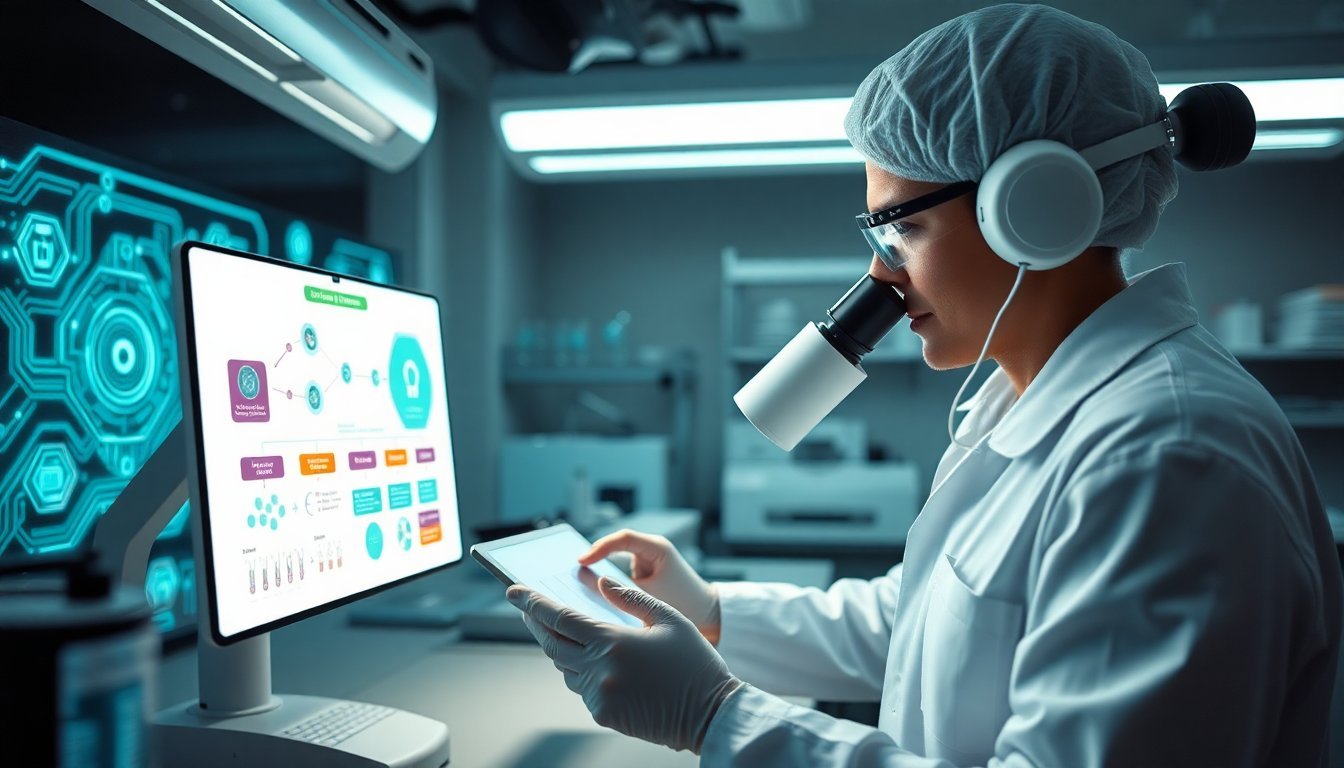
Agentic AI Closes the Semantic Gap in Scientific Workflows
The paper outlines how LLMs can interpret natural language into structured intents, validated generators produce reproducible workflows, and a runtime layer handles execution. This could dramatically reduce the time from idea to experiment for computational scientists.
A new arXiv preprint from April 2026 proposes an agentic architecture that bridges the gap between a scientist's research question and an executable scientific workflow. Instead of manually translating natural language into complex workflow specifications, the system uses three layers—semantic, validation, and execution—to automate the process while maintaining reproducibility.
- What happened: A team of researchers published a preprint on arXiv (April 2026) detailing an agentic architecture that automates the translation of research questions into scientific workflows.
- Why it matters: Scientists currently spend significant manual effort converting domain questions into workflow specifications, a task requiring both domain knowledge and infrastructure expertise. This system could automate that translation, accelerating scientific discovery.
- Key tension: The promise of speed versus the need for rigorous validation to ensure reproducibility and avoid automated errors at scale.
What Problem Does This Agentic Architecture Solve That Existing Workflow Systems Don't?
According to the arXiv preprint (arXiv:2604.21910v1), current scientific workflow systems such as Pegasus, Nextflow, and Snakemake excel at automating execution—handling scheduling, fault tolerance, and resource management. However, they leave a critical gap: the semantic translation from a research question to a formal workflow specification. Scientists must manually craft DAGs (Directed Acyclic Graphs), define data dependencies, and specify computational resources. This task demands both deep domain knowledge (to know what steps are needed) and infrastructure expertise (to know how to encode them). The proposed architecture introduces a semantic layer where an LLM interprets natural language into structured intents, bridging this gap.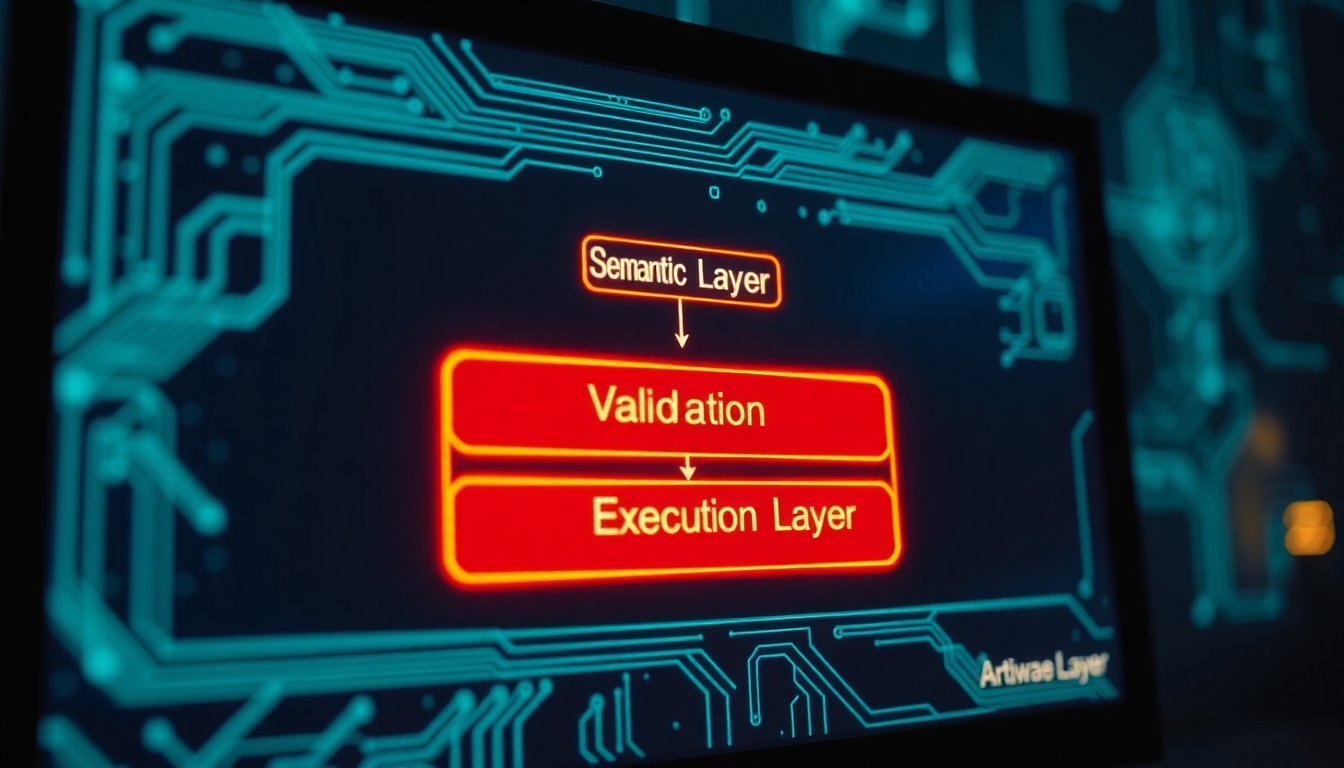
How Do the Three Layers Work Together to Ensure Reproducibility?
The architecture is divided into three layers. The semantic layer uses an LLM to parse natural language descriptions of research questions into structured intents—essentially, a formal representation of what the scientist wants to compute. The validation layer then takes these intents and uses validated generators to produce reproducible workflow specifications. According to the authors, this validation step is critical: it checks for logical consistency, resource feasibility, and adherence to domain-specific constraints before any execution begins. Finally, the execution layer handles the actual runtime, leveraging existing workflow engines for fault tolerance and scheduling. This separation of concerns means that even if the LLM produces a flawed intent, the validation layer can reject or correct it before it reaches execution.Who Benefits Most From This Automation—Bench Scientists or Workflow Engineers?
The primary beneficiaries are bench scientists and domain experts who lack deep infrastructure expertise. They can now describe their research question in natural language (e.g., "Run a GWAS analysis on this genomic dataset with standard QC filters") and have the system generate the corresponding workflow. This lowers the barrier to entry for computational science. Conversely, workflow engineers—those who currently specialize in translating research questions into executable DAGs—may see their role shift from manual translation to designing and maintaining the validation generators and LLM prompts. The paper does not address this workforce impact directly, but the implication is clear: the bottleneck moves from infrastructure knowledge to domain expertise in designing robust validation rules.What Are the Operational Tradeoffs of Adopting This Architecture?
| Factor | Current Manual Workflow | Proposed Agentic System |
|---|---|---|
| Time to workflow | Hours to days | Minutes to hours |
| Required expertise | Domain + infrastructure | Domain knowledge only |
| Reproducibility risk | Human error in encoding | LLM hallucination, validation gaps |
| Scalability | Bottlenecked by expert availability | Potentially unlimited |
| Control over details | High (manual tuning) | Lower (automated choices) |
| Verdict | Agentic system wins on speed and accessibility; manual workflows retain advantage for highly customized, sensitive experiments. | |
My thesis: This architecture is a genuine leap forward, but its success hinges entirely on the quality of the validation layer. In the short term, early adopters will likely use it for routine, well-understood analyses (e.g., standard bioinformatics pipelines). The long-term impact will be measured by whether the validation generators can be generalized across domains without requiring custom rules for every new experiment. The winners are computational scientists in resource-constrained labs who can now run sophisticated analyses without hiring a dedicated workflow engineer. The losers are workflow engineers whose manual translation skills will be devalued—though they may find new roles building and maintaining the validation layer. I predict that by Q1 2027, at least one major cloud provider (AWS, GCP, or Azure) will integrate a similar agentic layer into their scientific computing offerings, citing this preprint as foundational work.
What Remains Uncertain About This Approach?
The paper does not provide experimental results or benchmarks. It is a position paper outlining the architecture. Key uncertainties include: How robust is the LLM at handling ambiguous or poorly specified research questions? How expensive is the validation step in terms of compute and latency? Can the validation generators keep up with evolving domain standards? According to a Nature article on scientific reproducibility (Nature, 2023), even human-generated workflows often fail reproducibility checks—so automating the process without rigorous validation could amplify errors. The authors acknowledge this by emphasizing the validation layer, but they do not provide empirical evidence of its effectiveness.What Should a Lab or Institution Do to Prepare for This Shift?
First, invest in documenting existing workflows as structured intents—this will provide training data for the semantic layer. Second, start experimenting with LLM-based workflow generation on low-risk, well-understood pipelines to build confidence. Third, engage with the open-source community that will inevitably form around this architecture (the paper is on arXiv, so code and further iterations are likely). Finally, train domain scientists to critically review automatically generated workflows—the human-in-the-loop remains essential for the foreseeable future.- By Q1 2027, AWS will launch a managed service for agentic scientific workflow generation, citing this preprint as inspiration. The service will initially support common bioinformatics and climate modeling pipelines.
- By Q3 2027, at least one peer-reviewed study will be retracted due to an undetected error introduced by an LLM-generated workflow. This will trigger a community-wide debate on validation standards for automated science.
- By 2028, the role of "workflow curator" will emerge as a distinct job title—someone who designs and maintains the validation generators, rather than manually writing DAGs.
- Insight 1: The architecture's success depends less on the LLM's ability to parse language and more on the validation layer's ability to catch errors—this is where the real engineering challenge lies.
- Insight 2: Bench scientists will gain autonomy, but only if they develop enough computational literacy to review automated workflow outputs critically.
- Insight 3: The paper's lack of experimental results is a significant weakness; early adopters should proceed with caution and expect iterative refinement.
Source and attribution
arXiv
From Research Question to Scientific Workflow: Leveraging Agentic AI for Science Automation





Discussion
Add a comment