

Agent Plugins 1.0: GitHub Ends AI Plugin Lock-In
Agent Plugins 1.0 lets developers build once and run across every compatible client, breaking the plugin moats that defined the first AI coding wave. This analysis explains what changed, who wins, and what to do next.
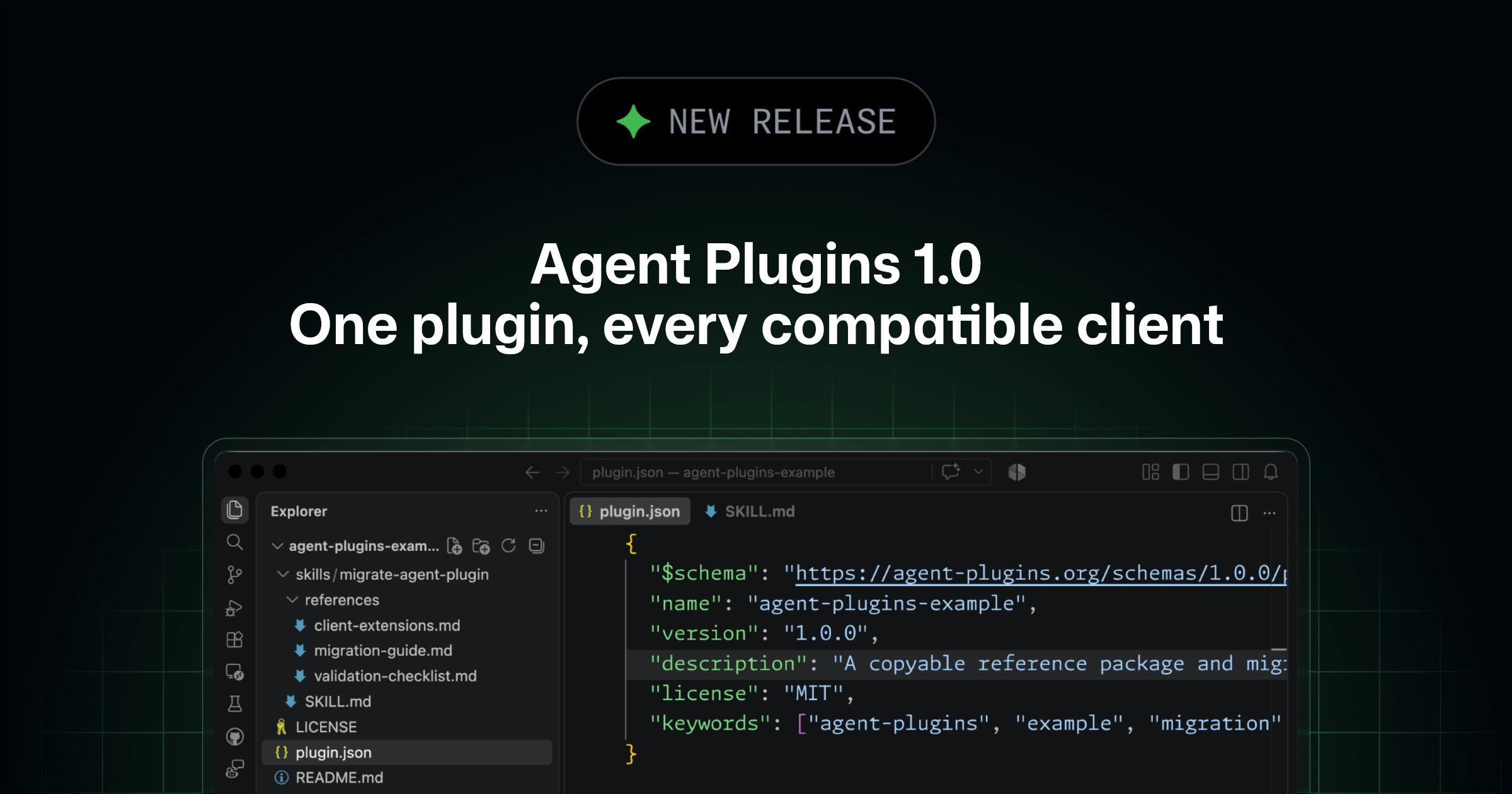
On August 12, 2026, GitHub announced that Agent Plugins 1.0 is now live in VS Code, the Copilot CLI, and the Copilot app — six days after the standard was published with AWS, Anysphere, Microsoft, OpenAI, and Vercel. This is the moment the AI coding plugin ecosystem stops being a collection of walled gardens and becomes a genuinely portable layer.
- GitHub shipped Agent Plugins 1.0 support in VS Code, Copilot CLI, and the Copilot app on August 12, 2026, six days after the standard launched with AWS, Anysphere, Microsoft, OpenAI, and Vercel.
- Developers can now build a plugin once and run it across all compatible agent clients, eliminating the need to write separate integrations for each tool.
- The key tension: this standardization commoditizes plugin distribution, forcing vendors to compete on client runtime quality, execution speed, and developer experience rather than exclusive integrations.
What Exactly Changed With Agent Plugins 1.0 on August 12?
According to the GitHub Changelog, the August 12, 2026 release brings Agent Plugins 1.0 to three surfaces: VS Code, the Copilot CLI, and the Copilot app. The post states: "You can now build a plugin once and use it across all compatible agent clients." This is the operational payoff of the standard that GitHub published on August 6 with AWS, Anysphere, Microsoft, OpenAI, and Vercel as founding partners.
What this means in practice: a plugin written for VS Code's Copilot extension now runs identically in the terminal-based Copilot CLI and the standalone Copilot app. The plugin manifest, tool definitions, and execution semantics are standardized. No more porting logic between three different APIs. The August 6 announcement also confirmed that Anysphere — the company behind Cursor — is a founding partner, which signals that the standard is designed to be client-agnostic rather than GitHub-centric.
Who Actually Benefits From This Standardization First?
Independent plugin developers and internal platform teams benefit first. According to the August 6, 2026 GitHub announcement, the founding partners include AWS, Anysphere, Microsoft, OpenAI, and Vercel — meaning a plugin built against Agent Plugins 1.0 can target all of their client surfaces without modification. For a startup building a code-review agent or a security scanning tool, this eliminates the cost of maintaining five separate plugin SDKs.
Large enterprises also win because they can standardize on one plugin architecture across their entire developer toolchain. If a team standardizes on VS Code but a contractor uses the CLI, the same plugin works in both. The loser here is any vendor that built a proprietary plugin ecosystem expecting to monetize exclusivity — JetBrains, which was not listed among the founding partners, now faces a standard it did not help define.
| Dimension | Agent Plugins 1.0 (GitHub-led) | Proprietary Plugin SDKs (Pre-August 2026) |
|---|---|---|
| Build once, run anywhere | Yes — across all compatible clients | No — separate SDK per client |
| Founding partners | AWS, Anysphere, Microsoft, OpenAI, Vercel | Single vendor per ecosystem |
| Plugin manifest | Standardized, versioned, open | Vendor-specific schema |
| Client support | VS Code, Copilot CLI, Copilot app | One client per SDK |
| Migration cost | Moderate — rewrite plugin manifest once | High — full rewrite per target |
| Verdict | Agent Plugins 1.0 wins on portability; proprietary SDKs only retain value for client-specific deep integrations. | |
What Are the Operational Tradeoffs of Adopting Agent Plugins 1.0?
The main tradeoff is abstraction overhead. A standardized plugin layer cannot expose every client-specific capability — the Copilot CLI has terminal-specific features that the VS Code extension does not, and vice versa. According to the GitHub Changelog, the standard covers "compatible agent clients," which means plugins that rely on deeply client-specific APIs may still need conditional code paths or fallbacks.
The second tradeoff is versioning discipline. With a single plugin targeting multiple clients, you must test against all of them. A bug that only manifests in the CLI but not VS Code becomes your problem, not the platform's. Teams need a CI matrix that runs plugin tests across each target client. The third tradeoff is timing: the standard is only days old, and the founding partners have not all shipped production support yet. Early adopters will be debugging against a moving target.
What Should Development Teams Do in the Next 90 Days?
First, audit your existing plugins. Categorize them by how much they rely on client-specific APIs. If a plugin only uses standard tool-calling primitives, port it to Agent Plugins 1.0 immediately. If it deeply integrates with VS Code's editor APIs, wait for the standard to mature before migrating. Second, set up a cross-client test matrix now. According to GitHub's August 12 changelog, the standard is live in VS Code, the CLI, and the app — so you can test all three surfaces today, not in six months.
Third, for teams building internal agents, standardize on Agent Plugins 1.0 for new work. The founding partner list — AWS, Anysphere, Microsoft, OpenAI, and Vercel — represents the distribution channels your agents will need to reach. Building against the standard today means your plugin is ready when each vendor fully ships support. Fourth, monitor JetBrains and other non-founding vendors. If they adopt the standard, it becomes the universal layer; if they resist, you will face a fork in the ecosystem.
My thesis: Agent Plugins 1.0 is the most consequential standardization event in AI coding since GitHub Copilot launched, because it commoditizes plugin distribution and forces every vendor to compete on runtime quality instead of exclusive integrations.
Short-term, the winners are Anysphere and Vercel — both are founding partners with strong developer mindshare, and both can now offer their users a plugin ecosystem without building one from scratch. GitHub wins by positioning itself as the neutral arbiter rather than a proprietary gatekeeper. The clear loser is JetBrains, which was conspicuously absent from the founding list and now faces a standard it does not control; its plugin ecosystem was a competitive moat, and that moat just evaporated. OpenAI's participation is notable because it suggests even the model leader sees distribution standardization as inevitable.
Long-term, the value shifts from plugin catalogs to execution quality. When every client runs the same plugin, the differentiator becomes how fast, reliably, and securely the client executes agent workflows. This favors clients with strong sandboxing and observability — areas where the Copilot CLI's terminal-native design may actually be an advantage over heavyweight IDEs. I predict that within 12 months, the plugin marketplace model will follow the app-store trajectory: distribution becomes free, and money moves to runtime infrastructure and managed plugin services.
What Are the Falsifiable Predictions for This Ecosystem?
- By Q2 2027, JetBrains will announce support for Agent Plugins 1.0 in IntelliJ IDEA, conceding that its proprietary plugin SDK cannot compete with an open standard backed by five major vendors.
- By December 2026, at least three of the five founding partners (AWS, Anysphere, Microsoft, OpenAI, Vercel) will ship production-grade Agent Plugins 1.0 runtime support beyond the current GitHub surfaces, and the standard will be adopted by at least one major non-founding client.
- By mid-2027, a third-party plugin marketplace will emerge that distributes Agent Plugins 1.0 packages across all compatible clients, and it will capture more than 30% of new AI coding plugin downloads within its first six months.
- August 2026Agent Plugins 1.0 standard published
GitHub published the Agent Plugins 1.0 specification with AWS, Anysphere, Microsoft, OpenAI, and Vercel as founding partners.
- August 2026Client support shipped
GitHub announced Agent Plugins 1.0 support in VS Code, the Copilot CLI, and the Copilot app.
Article Summary
- Agent Plugins 1.0 is a distribution standard, not a feature — it changes where competitive value lives in the AI coding stack.
- The founding partner list is the real story: AWS, Anysphere, Microsoft, OpenAI, and Vercel all agreed that no single vendor should own the plugin layer.
- Teams should port standard plugins now but wait on client-specific deep integrations until the standard stabilizes.
- JetBrains' absence from the founding list is a strategic vulnerability that will force a public response within 12 months.
- The next battleground is runtime quality — execution speed, sandboxing, and observability — not plugin catalog size.
Source and attribution
GitHub Changelog
Agent Plugins 1.0 in VS Code, Copilot CLI, and the Copilot app




Discussion
Add a comment