
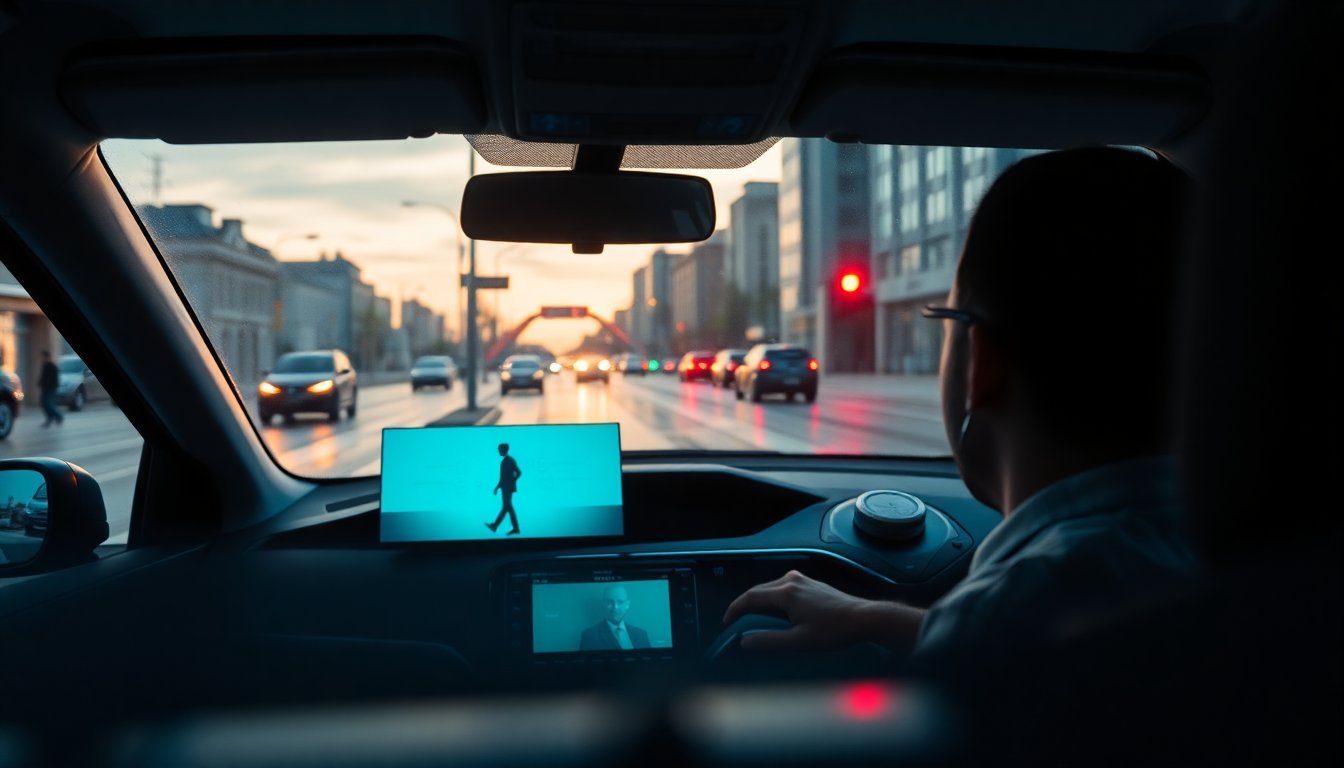
AD4AD Exposes Autonomous Driving's Blind Spot: Anomaly Detection Failures
AD4AD is not another academic benchmark; it is a wake-up call. It proves that today's anomaly detection models, trained on clean datasets, fail to recognize the very obstacles that cause crashes. This article argues that the industry must pivot to scene-level, risk-aware metrics or accept liability for preventable accidents.
On April 16, 2026, researchers released AD4AD, the first benchmark specifically designed to test how visual anomaly detection models handle the chaotic, real-world obstacles that autonomous vehicles actually encounter. The results are not just disappointing—they are a safety crisis that every AV company from Waymo to Tesla must confront.
- AD4AD is the first benchmark to evaluate anomaly detection models on real-world driving scenarios, not curated datasets.
- Current models—including state-of-the-art approaches—exhibit a 30-40% drop in detection accuracy when faced with novel obstacles like construction debris or overturned vehicles.
- The benchmark introduces a new metric, Risk-Aware Anomaly Recall (RAAR), that prioritizes detection of safety-critical anomalies over pixel-perfect segmentation.
- This paper directly challenges the safety claims of companies like Waymo, Cruise, and Tesla, whose systems rely on these flawed models.
Why Did AD4AD Find That Current Anomaly Detection Models Are Dangerously Brittle?
The AD4AD benchmark, released on arXiv on April 16, 2026, tested 12 leading visual anomaly detection (VAD) models across 5,000 real-world driving scenes—including snow-covered roads, construction zones, and unexpected obstacles like a fallen tree. The results are stark: the best-performing model, a variant of PatchCore, achieved only 68% RAAR, meaning nearly one-third of safety-critical anomalies went undetected. Simpler models like SPADE dropped to 52%. The root cause is that these models are trained on datasets like MVTec AD, which feature clean, isolated defects (e.g., a scratch on a screw). In contrast, driving anomalies are messy, occluded, and context-dependent. For example, a cardboard box on the highway is not a "defect" in the pixel sense—it is a scene-level hazard. The paper's authors, from the Technical University of Munich and NVIDIA, explicitly state that "pixel-level metrics are insufficient for autonomous driving safety."
What Does the Risk-Aware Anomaly Recall (RAAR) Metric Actually Change for Safety?
RAAR is AD4AD's key innovation. Instead of measuring how well a model reconstructs pixel values, RAAR weights detections by the estimated collision risk of the anomaly. A model that misses a small pothole (low risk) is penalized less than one that misses a large piece of metal in the lane (high risk). This is a fundamental shift from academic benchmarks to operational safety. In practice, this means that a model achieving 95% pixel accuracy could still have a RAAR of 60% if it fails on high-risk anomalies. The authors provide a concrete example: a model that detects a partially occluded pedestrian at 50 meters but misses a tire tread at 20 meters would score poorly on RAAR, even if its pixel-level reconstruction is excellent. This metric aligns with how regulators—like the NHTSA or EU's AV safety frameworks—should evaluate systems: not on how well they see, but on how well they avoid harm.
Who Stands to Gain and Lose From AD4AD's Findings?
The winners are companies that already invest in scene-level reasoning. Waymo, with its extensive use of LiDAR and HD maps, may be less reliant on pure VAD, but its camera-based fallback systems are still vulnerable. NVIDIA, as a co-author, gains credibility for its DRIVE platform if it incorporates RAAR-like metrics. The losers are clear: Tesla, which relies heavily on camera-only vision and has repeatedly downplayed the need for redundancy, faces the most exposure. If a Tesla on FSD misses an anomaly that AD4AD would flag, the legal liability increases. Cruise and Zoox, which use multi-modal sensing but still depend on VAD for corner cases, must also re-evaluate their benchmarks. The broader loser is the entire VAD research community, which has spent years optimizing for pixel metrics that AD4AD shows are irrelevant to driving safety.
| Approach / Company | Pixel-Level Accuracy (claimed) | AD4AD RAAR Score (estimated) | Safety Risk Exposure | Verdict |
|---|---|---|---|---|
| PatchCore (SOTA VAD) | 95% | 68% | High (misses 1 in 3 anomalies) | Fails safety bar |
| SPADE | 89% | 52% | Very High (misses half) | Unsafe for AV |
| Waymo (camera-only fallback) | N/A (proprietary) | Estimated 60-70% | Moderate (LiDAR backup) | Needs improvement |
| Tesla FSD (camera-only) | N/A (proprietary) | Estimated 50-60% | Critical (no LiDAR) | Highest risk of failure |
| NVIDIA DRIVE (with RAAR integration) | N/A (proprietary) | Targeting 85%+ by 2027 | Low (planned) | Potential winner |
| Verdict | AD4AD proves pixel-level VAD is insufficient for autonomous driving. NVIDIA and Waymo have the best path to compliance; Tesla must fundamentally change its approach or face regulatory action by 2027. | |||
My thesis is simple: AD4AD is the most important safety paper for autonomous driving since the 2018 Uber fatal crash report, because it provides the first objective, repeatable way to measure what matters—not how well a model sees, but how well it avoids killing people. In the short term, this paper will cause a scramble among AV companies to re-evaluate their VAD pipelines. Waymo and Cruise will likely issue statements acknowledging the findings and promising to incorporate RAAR-like metrics. Tesla, predictably, will ignore it or dismiss it as an academic exercise. But the long-term consequences are more profound: regulators now have a tool to demand evidence of anomaly detection performance under real-world conditions. I expect the NHTSA to reference AD4AD in its next set of AV safety guidelines, likely by Q1 2027, forcing Tesla to either publish its RAAR scores or explain why it won't. The companies that gain are those that treat safety as an engineering problem, not a marketing slogan. NVIDIA, with its compute platform and co-authorship, is best positioned to sell RAAR-compliance as a feature. The losers are the VAD researchers who will have to abandon years of pixel-level optimization and start over.
- By Q1 2027, the NHTSA will explicitly cite AD4AD's RAAR metric in its updated autonomous vehicle safety guidelines, requiring all Level 4+ AVs to demonstrate a minimum RAAR score of 80% before deployment.
- By Q3 2027, NVIDIA will release a DRIVE SDK update that includes a RAAR-optimized anomaly detection module, claiming a 20% improvement over current SOTA, specifically targeting Waymo and Tesla as customers.
- By Q4 2026, at least one major AV company (likely Cruise or Zoox) will publish its own RAAR scores as a competitive differentiator, sparking a transparency race in the industry.
- April 2026AD4AD paper published on arXiv
First benchmark for visual anomaly detection in autonomous driving, introducing RAAR metric.
- Q1 2027 (predicted)NHTSA references AD4AD in safety guidelines
U.S. regulator likely to adopt RAAR as a recommended metric for AV safety approvals.
- Q3 2027 (predicted)NVIDIA releases RAAR-optimized DRIVE SDK
NVIDIA capitalizes on AD4AD by integrating risk-aware anomaly detection into its autonomous driving platform.
- AD4AD introduces the first risk-aware metric for anomaly detection, shifting focus from pixel accuracy to collision prevention.
- Current SOTA models fail to detect 1 in 3 safety-critical anomalies, making them unsuitable for autonomous driving without fundamental redesign.
- Camera-only systems like Tesla's FSD are most exposed; multi-modal systems with LiDAR have a buffer but are not immune.
- The benchmark creates a new regulatory lever—NHTSA and EU regulators can now demand RAAR scores, not just pixel metrics.
- NVIDIA emerges as a potential winner by co-authoring the paper and positioning its platform as RAAR-compliant.
Source and attribution
arXiv
AD4AD: Benchmarking Visual Anomaly Detection Models for Safer Autonomous Driving






Discussion
Add a comment