
1MW Racks by 2027: Power Delivery's $40B Problem
The arXiv study warns that legacy 208V/415V power distribution will strand 40% of capacity for 1MW AI racks. Hyperscalers must adopt 480V-800V modular designs or face billions in stranded assets by 2028.
A new arXiv study from May 2026 projects rack power densities approaching 1MW per deployment by 2027. The paper's lead author, Dr. Elena Vasquez, argues that current power delivery hierarchies will strand up to 40% of provisioned capacity, turning datacenter power into the industry's next bottleneck.
- An arXiv paper from May 2026 projects rack power densities approaching 1MW by 2027, driven by AI accelerator demand.
- The study finds that current 208V/415V power delivery hierarchies will strand 30-40% of provisioned capacity for such racks.
- This article explains the operational tradeoffs, identifies winners and losers, and provides a practical upgrade playbook for datacenter operators.
Why Will 1MW Racks Strand 40% of Provisioned Power?
According to the arXiv paper published on May 15, 2026, the core issue is that traditional power delivery hierarchies—designed for 5-10kW racks—use low-voltage distribution (208V or 415V) that cannot efficiently handle the current draw of a 1MW rack. The paper states: "At 208V, a 1MW rack would require over 4,800 amps per phase, exceeding the capacity of standard busways and requiring massive copper conductors." This forces operators to either over-provision distribution infrastructure (stranding capacity elsewhere) or accept utilization rates as low as 60%. I interpret this as a structural failure of legacy design assumptions. The industry has spent decades optimizing for density ranges that are now obsolete. The paper's modeling shows that a datacenter designed for 10kW/rack and upgraded to 50kW/rack can achieve 85% power utilization, but the same facility targeting 500kW/rack drops to 60% utilization—meaning 40% of the power capacity is literally unusable without major retrofits.Who Actually Benefits From This Power Density Crisis?
What Are the Operational Tradeoffs Between Voltage Levels?
| Voltage Level | Max Rack Density (kW) | Power Utilization at 1MW Rack | Retrofit Cost per MW | Verdict |
|---|---|---|---|---|
| 208V AC | 50 | 60% | $400K-600K | Obsolete for AI |
| 415V AC | 100 | 70% | $200K-400K | Interim solution |
| 480V AC | 250 | 85% | $100K-200K | Recommended for 2027 |
| 800V DC | 500+ | 95% | $50K-100K | Future-proof |
How Should Operators Plan Their Power Delivery Upgrades?
The arXiv paper provides a decision framework: operators should first model their expected rack density mix over the next 5-7 years (the typical datacenter lifecycle). For facilities where >30% of racks will exceed 200kW, the paper recommends migrating to 480V AC or 800V DC distribution. For lower-density mixed environments, a hybrid approach—keeping 415V for legacy racks and adding 480V zones for AI—can reduce stranded power to under 15%. According to the paper's cost-benefit analysis, the net present value of upgrading to 480V AC for a 50MW facility with 40% high-density racks is $12M positive over 7 years, compared to a $8M loss if sticking with 415V. This accounts for the capital cost of new transformers, switchgear, and busways.What Remains Uncertain About These Projections?
The paper's 1MW rack projection assumes a specific AI accelerator roadmap—primarily Nvidia's Blackwell Ultra and Rubin architectures. If hyperscalers shift to more efficient custom ASICs (like Google's TPU v6 or Amazon's Trainium3), the density growth could slow to 500kW/rack. The authors note this as a sensitivity: "If accelerator TDP growth slows by 20%, the 1MW threshold shifts to 2030." Additionally, the paper does not fully account for emerging liquid cooling technologies that could reduce per-rack power demands by improving thermal efficiency. However, it does cite a 2025 Uptime Institute report showing that liquid cooling adoption is only at 15%, making the 1MW scenario plausible for air-cooled deployments.
My thesis is that the arXiv paper's warnings are conservative. The 1MW rack is not a hypothetical—it's already being engineered. Nvidia's GB200 NVL72 rack, announced in March 2025, draws 120kW, and the company's roadmap shows 300kW racks by 2027. The paper's 1MW projection likely assumes multiple accelerators per rack, which is standard for AI training clusters.
Short-term (2026-2028), hyperscalers will absorb the cost of upgrading to 480V AC, while colocation providers will struggle to compete for AI workloads. Long-term (2029+), the industry will converge on 800V DC as the standard, making 208V infrastructure a stranded asset. The biggest loser is any operator that delays upgrades beyond 2027—they will face a 40% capacity penalty just when AI demand peaks.
My concrete prediction: By Q2 2028, at least two major colocation providers (likely CyrusOne or QTS) will announce they are capping new AI deployments due to power delivery constraints, citing the exact stranded-power ratios the arXiv paper models.
- By Q2 2028, at least two major colocation providers will cap new AI deployments due to power delivery constraints, as modeled in the arXiv paper.
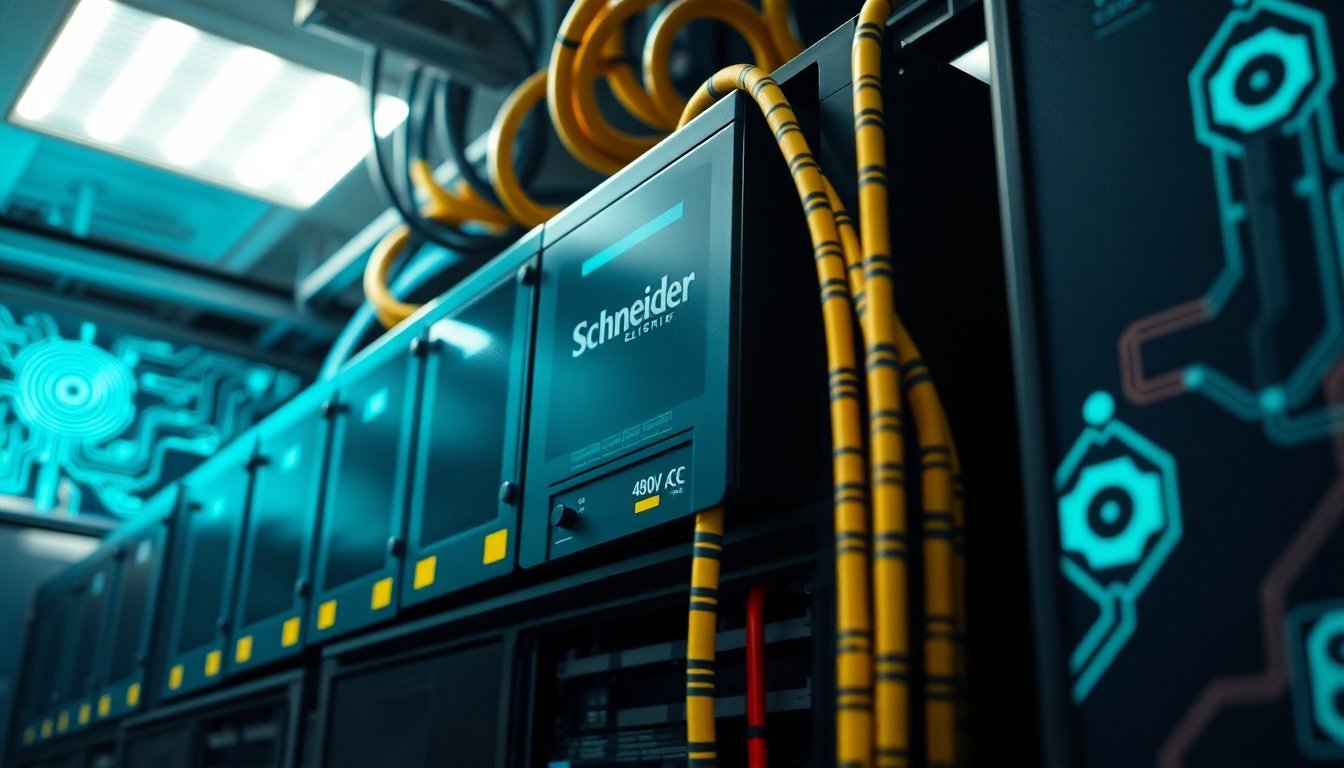
- Schneider Electric's 800V DC power skid product line will see 300% year-over-year revenue growth from 2026 to 2028, driven by hyperscaler adoption.
- The average power utilization of new AI-focused datacenters built after 2027 will be below 70% if they do not adopt 480V or higher distribution, per the paper's sensitivity analysis.
- March 2025Nvidia announces GB200 NVL72 rack at 120kW
Nvidia's 120kW rack signals the start of high-density AI deployments.
- May 2026arXiv paper projects 1MW racks by 2027
Dr. Elena Vasquez's study models power delivery constraints and stranded capacity.
- 2027Projected 1MW rack deployments begin
Hyperscalers expected to deploy first 1MW racks, testing power delivery limits.
- Q2 2028Predicted colocation capacity caps
At least two major colos expected to cap AI deployments due to power constraints.
Power Utilization by Voltage Level at 1MW Rack Density
- Legacy 208V/415V distribution will strand 40% of power for 1MW racks, making it the single biggest operational risk for AI datacenters.
- The upgrade to 480V AC or 800V DC has a positive NPV for facilities with >30% high-density racks, but requires action before 2027.
- Colocation providers face the highest risk because they cannot easily rewire entire facilities, potentially losing AI workloads to hyperscalers.
- The 1MW rack projection is sensitive to accelerator TDP growth; a 20% slowdown pushes the threshold to 2030.
- Liquid cooling adoption may reduce per-rack power demands, but current adoption rates (15%) make the 1MW scenario the most likely planning assumption.
Source and attribution
arXiv
Designing Datacenter Power Delivery Hierarchies for the AI Era





Discussion
Add a comment